Counseling vs counselling is a common spelling question for writers, students, and professionals who use different varieties of English. Both spellings are correct, but their preferred usage depends on the country. Counseling is the standard American English spelling, while counselling is generally preferred in British, Australian, Canadian, and New Zealand English.
The difference comes down to regional spelling conventions, not meaning. Both words describe the process of providing professional guidance, emotional support, and advice to help people manage personal, psychological, educational, or relationship challenges. Whether you are writing about mental health counseling, professional counselling services, or psychological support, the two spellings refer to the same general practice.
| Question | Answer |
| Is counseling or counselling correct? | Both are correct spellings. |
| What is the American spelling? | Counseling (one L). |
| What is the British spelling? | Counselling (two Ls). |
| Is it counselling or counseling in Australia and Canada? | Counselling is generally preferred in both countries. |
| Do counseling and counselling have different meanings in psychology? | No. Both describe the same general professional practice. |
Counseling vs Counselling: What’s the Difference?
Counseling and counselling have the same meaning, pronunciation, and grammatical function. The only difference is their spelling. American English uses one L in counseling, while British English retains two Ls in counselling. The appropriate choice depends on your audience, location, and preferred English style.
Counseling: The American English Spelling
Counseling is the standard spelling in American English. It follows the US convention of using a single L in certain words formed from verbs ending in L.
Americans use this spelling in everyday communication, academic writing, healthcare documents, educational programs, and professional settings.
For example, a university in the United States might advertise a student counseling program. Similarly, a mental health clinic may offer individual counseling, family counseling, or relationship counseling.
The spelling also appears in professional titles and related expressions.
Common American English forms include:
- Counseling
- Counselor
- Counseled
- Counseling session
- Mental health counseling
- Career counseling
- Marriage counseling
Example sentences:
- My university offers free career counseling to graduating students.
- She started counseling to manage stress and improve her emotional well-being.
- The school hired a new counselor to support students.
- Their marriage counseling sessions helped them communicate more effectively.
- The company provides professional counseling services to employees.
In each example, the single-L spelling follows standard American English conventions.
Counselling: The British English Spelling
Counselling is the standard spelling in British English. It follows a different spelling convention that retains the double L in words derived from certain verbs.
Writers in the United Kingdom commonly use this version in education, healthcare, psychology, and professional communication.
For example, a British university may provide student counselling services, while a healthcare organization might offer mental health counselling to people experiencing emotional difficulties.
Related British English forms include:
- Counselling
- Counsellor
- Counselled
- Counselling session
- Mental health counselling
- Career counselling
- Marriage counselling
Example sentences:
- The school provides counselling services for students.
- She decided to seek professional counselling after a difficult experience.
- My counsellor helped me develop better coping strategies.
- The organization offers free career counselling to young adults.
- Couples can attend marriage counselling to address relationship problems.
These examples use the British spelling consistently.
Do Counseling and Counselling Have Different Meanings?
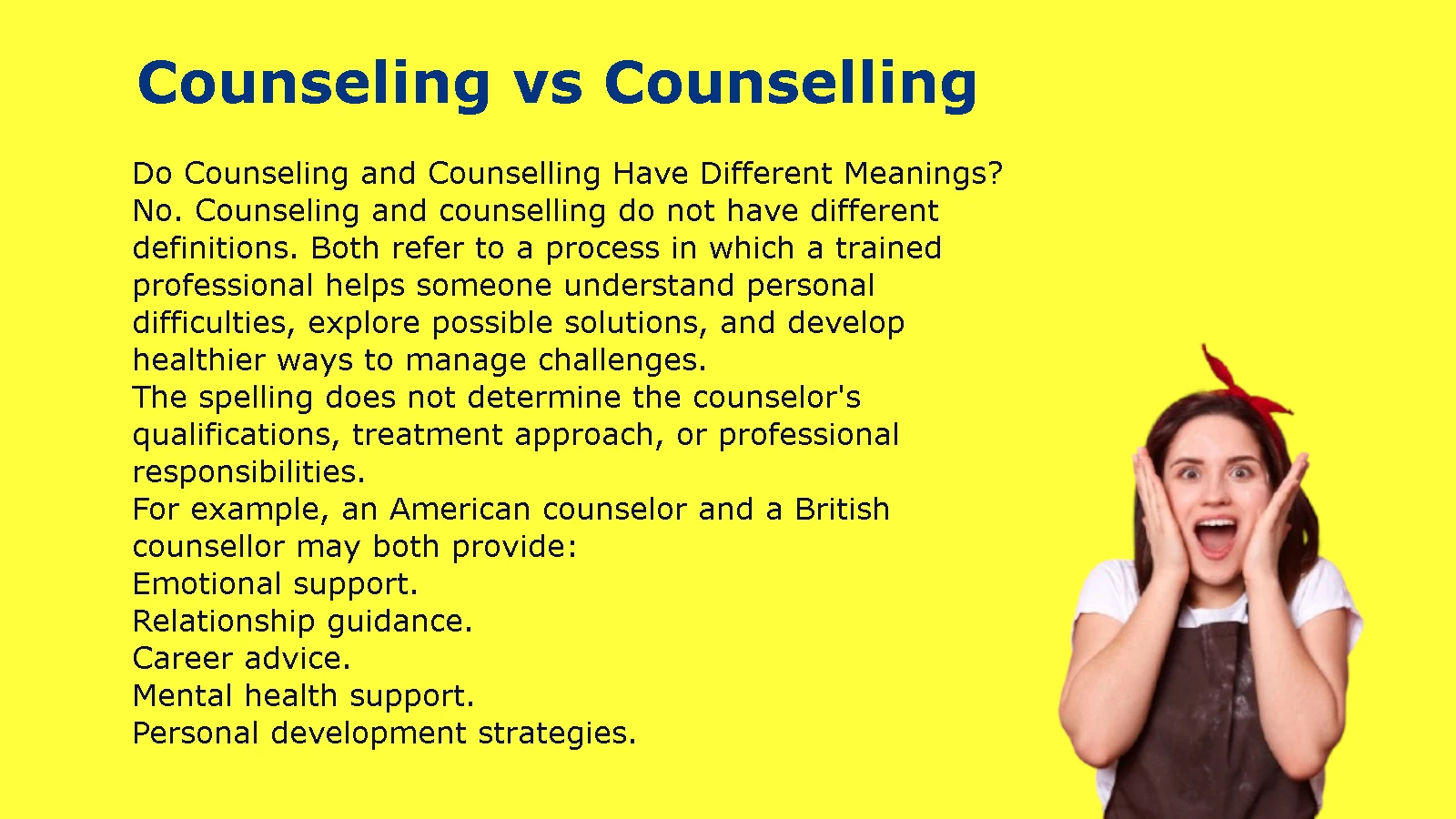
No. Counseling and counselling do not have different definitions. Both refer to a process in which a trained professional helps someone understand personal difficulties, explore possible solutions, and develop healthier ways to manage challenges.
The spelling does not determine the counselor’s qualifications, treatment approach, or professional responsibilities.
For example, an American counselor and a British counsellor may both provide:
- Emotional support.
- Relationship guidance.
- Career advice.
- Mental health support.
- Personal development strategies.
- Help with stress management.
- Guidance during difficult life changes.
Their professional approaches depend on their training, qualifications, and areas of specialization, not the spelling of their job titles.
The key distinction is geographical: counseling belongs to American English, while counselling generally belongs to British English and several other English varieties.
Counseling or Counselling: Which Is Correct?
Both counseling and counselling are correct. Neither spelling is universally better or more accurate. American writers should generally use counseling, while British, Australian, and Canadian writers commonly use counselling. Always consider your intended audience and follow the spelling conventions of your publication or organization.
When to Use Counseling
Use counseling when writing for an American audience or following American English spelling conventions.
This spelling is appropriate for:
- US academic assignments.
- American healthcare publications.
- Mental health websites targeting US readers.
- Professional documents written in American English.
- Educational and career guidance materials.
- Business communication intended for American organizations.
For example:
Correct: The college provides free counseling to students who need academic or emotional support.
Less suitable for standard US writing: The college provides free counselling to students who need academic or emotional support.
The second version is understandable, but it does not follow the usual American spelling convention.
You should also use related American forms consistently.
| American spelling | Example |
| Counseling | She attends weekly counseling. |
| Counselor | Her counselor recommended several strategies. |
| Counseled | The students were counseled about their options. |
When to Use Counselling
Use counselling when writing for readers who follow British English spelling conventions.
This version is commonly used in:
- UK academic writing.
- British healthcare publications.
- Australian educational materials.
- Canadian professional documents.
- British mental health websites.
- International publications that follow British English.
For example:
Correct: The university offers free counselling to students who experience anxiety or academic difficulties.
Less suitable for standard British writing: The university offers free counseling to students who experience anxiety or academic difficulties.
The first version follows the usual British spelling preference.
Related forms also use the double L:
| British spelling | Example |
| Counselling | She attends weekly counselling. |
| Counsellor | Her counsellor recommended several strategies. |
| Counselled | The students were counselled about their options. |
How to Choose the Right Spelling
Choosing between counseling and counselling becomes easier when you identify your audience before writing.
Use this simple approach:
Identify your target country. Determine whether your readers primarily use American, British, Australian, or Canadian English.
Follow the appropriate spelling convention. Use counseling for American audiences and counselling for audiences that generally follow British spelling.
Check your publication’s style guide. Universities, newspapers, healthcare organizations, and professional associations may have specific editorial preferences.
Maintain consistency. Avoid switching between counseling and counselling within the same article unless you are directly comparing the two forms.
For example, if you are writing a website article for American readers, use counseling throughout the page. That includes headings, body text, image descriptions, and related expressions.
Consistency makes your writing easier to read and gives your content a more professional appearance.
Counseling vs Counselling in Different Countries
The preferred spelling of counseling varies across English-speaking countries. American English generally uses counseling, whereas British English, Australian English, and Canadian English commonly use counselling. These differences reflect regional spelling conventions rather than differences in the meaning or practice of counseling.
Counseling or Counselling in the United States
In the United States, counseling is the accepted standard spelling.
American English generally uses a single L when forming certain words from verbs ending in L. The same convention appears in words such as traveling, labeling, and canceled.
The spelling counseling follows this pattern.
Americans commonly use it in several professional and educational contexts:
- Mental health counseling.
- School counseling.
- Career counseling.
- Marriage counseling.
- Substance abuse counseling.
- Professional counseling services.
For example, an American university might advertise a bachelor’s degree in counseling or offer counseling services through its student support department.
A mental health organization may also use terms such as licensed professional counselor, counseling psychology, and individual counseling.
Example:
The school district introduced a new counseling program to help students manage academic pressure and personal difficulties.
The single-L spelling is the appropriate choice in this American English sentence.
Counseling or Counselling in the United Kingdom
In the United Kingdom, counselling is the preferred spelling.
British English generally retains the double L in certain words formed from verbs ending in L. This convention appears in words such as travelling, labelling, and cancelled.
The same pattern explains the spelling of counselling.
British writers use it in professional, educational, and everyday contexts.
Common expressions include:
- Mental health counselling.
- Relationship counselling.
- School counselling.
- Career counselling.
- Bereavement counselling.
- Professional counselling services.
Example:
The community health center provides counselling for individuals dealing with anxiety, grief, and relationship difficulties.
The double-L spelling follows standard British English usage.
It is also common in professional descriptions, job advertisements, educational programs, and healthcare information.
Counseling or Counselling in Australia
In Australia, counselling is generally the preferred spelling.
Australian English follows many British spelling conventions, including the use of double L in words such as travelling, modelling, and counselling.
This spelling appears across Australian educational, healthcare, and professional settings.
For example:
- Counselling services.
- Mental health counselling.
- Career counselling.
- School counsellor.
- Relationship counselling.
- Professional counsellor.
Example:
The Australian university provides free counselling services to help students manage stress, academic pressure, and personal challenges.
The double-L spelling is appropriate for Australian English.
If you are creating website content for an Australian audience, use counselling consistently. You should also consider related regional spellings and the terminology used by Australian professional organizations.
Counseling or Counselling in Canada
In Canada, counselling is commonly preferred, although Canadian English includes spelling conventions influenced by both British and American English.
This combination can make Canadian spelling more complicated than a simple US-versus-UK comparison.
For example, Canadian English often uses British-style spellings such as colour and centre, while other words follow American conventions.
Counselling is commonly used in Canadian educational, healthcare, and professional contexts.
Examples include:
- Mental health counselling.
- Career counselling.
- School counselling.
- Family counselling.
- Counselling services.
- Professional counsellor.
Example:
The Canadian college provides counselling services to students who need academic guidance or emotional support.
The double-L spelling is a common Canadian choice.
However, spelling preferences can vary between organizations. A Canadian institution may use a particular spelling in its official name or publications. When writing formal material, follow the organization’s established terminology.
Quick Comparison of Regional Spellings
The following table summarizes the commonly preferred spellings across several English-speaking countries.
| Country | Preferred spelling | English variety |
| United States | Counseling | American English |
| United Kingdom | Counselling | British English |
| Australia | Counselling | Australian English |
| Canada | Counselling (commonly preferred) | Canadian English |
| New Zealand | Counselling | New Zealand English |
Practical tip: If you are unsure which version to choose, identify your readers’ location and follow the spelling used by their educational institutions, healthcare providers, or professional organizations.
What Does Counseling or Counselling Mean?
Counseling or counselling means providing professional guidance and support to help people understand personal difficulties, make informed decisions, and develop strategies for dealing with emotional, psychological, social, or practical challenges. The process often involves conversations between a trained professional and an individual, couple, family, or group.
General Definition of Counseling
Counseling is a professional helping process that allows people to discuss concerns, understand their circumstances, and explore practical ways to improve their lives.
A counselor does not simply tell someone what to do. Instead, the professional helps the individual examine different perspectives, identify possible solutions, and make decisions that suit their needs.
For example, someone experiencing workplace stress might attend counseling to understand the causes of their anxiety and develop healthier ways to manage professional responsibilities.
Similarly, a student who struggles with academic pressure might speak with a counselor about study habits, motivation, time management, and personal challenges.
Counseling can address several areas of life, including:
- Emotional well-being: Managing sadness, anger, frustration, and stress.
- Relationships: Improving communication and resolving conflicts.
- Career development: Exploring professional interests and making career decisions.
- Education: Addressing academic challenges and developing study strategies.
- Personal growth: Building confidence, self-awareness, and decision-making skills.
- Life transitions: Adjusting to major changes such as retirement, relocation, or bereavement.
The exact process depends on the person’s circumstances and the counselor’s professional training.
What Is the Meaning of Counselling in Psychology?
In psychology, counselling refers to a professional process that helps individuals understand their thoughts, emotions, behaviors, and personal experiences.
It provides a structured environment where people can discuss concerns without feeling judged. A qualified professional uses appropriate psychological knowledge, communication skills, and evidence-informed approaches to help clients work toward their goals.
Psychological counselling may address:
- Anxiety and persistent worry.
- Low self-confidence.
- Relationship difficulties.
- Grief and bereavement.
- Workplace stress.
- Family conflicts.
- Emotional distress.
- Personal adjustment difficulties.
For example, someone who experiences anxiety before public speaking might seek psychological counselling.
During sessions, the counsellor may help the individual identify negative thought patterns, understand emotional triggers, and practice techniques for managing anxiety.
The goal is not simply to remove uncomfortable feelings. It is also to help people develop practical skills that support their long-term well-being.
Counselling and counseling have exactly the same general psychological meaning. The spelling depends on the English variety used by the writer.
Common Types of Counseling
Counseling covers several areas of professional support. Each type focuses on particular concerns, although some services may overlap.
Mental Health Counseling
Mental health counseling helps people address emotional and psychological difficulties. It may involve support for anxiety, depression, stress, trauma-related concerns, and other challenges.
For example, someone experiencing persistent anxiety might work with a mental health counselor to understand their symptoms and develop coping strategies.
Career Counseling
Career counseling helps people explore professional opportunities, identify strengths, and make informed employment decisions.
A career counselor may help someone choose a university course, prepare for a career change, or identify suitable professional goals.
Marriage and Relationship Counseling
Marriage counseling helps couples address relationship difficulties, improve communication, and understand recurring conflicts.
For example, partners who struggle to discuss financial decisions may attend counseling to develop healthier communication habits.
Family Counseling
Family counseling focuses on relationships and communication between family members.
It may help families manage disagreements, adjust to major changes, or understand conflicts involving parents, children, and other relatives.
School and Academic Counseling
School counselors may help students develop study habits, explore future careers, and manage difficulties that affect their education.
Grief and Bereavement Counseling
Grief counseling supports people who are coping with the loss of someone important.
A counselor may help someone understand their emotional responses, adjust to changes, and find healthy ways to manage bereavement.
Is Counseling the Same as Therapy?
Counseling and therapy are closely related, but they are not always identical.
Both can involve professional conversations, emotional support, and psychological strategies. However, their focus, duration, and methods may differ depending on the professional, the client’s needs, and the type of service.
| Aspect | Counseling | Therapy |
| General focus | Guidance, support, and addressing specific concerns | Exploring psychological difficulties and supporting behavioral or emotional change |
| Common goals | Decision-making, coping skills, and personal development | Understanding patterns, managing symptoms, and improving psychological well-being |
| Duration | May be short-term or ongoing | May be short-term or long-term |
| Methods | Supportive conversations and structured interventions | May include structured psychological treatments and other therapeutic approaches |
| Areas covered | Relationships, careers, stress, and personal challenges | Anxiety, depression, trauma-related concerns, and other psychological difficulties |
These distinctions are general rather than absolute.
Some counselors provide psychotherapy, and some therapists offer counseling services. The professional’s qualifications, training, and scope of practice matter more than the title alone.
For example, a person experiencing relationship difficulties may benefit from counseling focused on communication. Someone experiencing persistent psychological symptoms may need a more structured therapeutic approach.
The most appropriate service depends on the individual’s needs.
Counseling vs Counselling Examples in Sentences
The easiest way to understand counseling vs counselling is to compare the two spellings in actual sentences.
Both forms work in the same grammatical situations. You simply change the spelling to match your chosen English variety.
Examples Using Counseling
The following sentences use the standard American English spelling.
- The university provides free counseling to students who experience academic stress.
- She decided to seek professional counseling after struggling with anxiety.
- My career counselor helped me identify suitable employment opportunities.
- The organization offers marriage counseling to couples experiencing relationship problems.
- Parents can contact the school counselor for guidance about their children’s education.
- The company introduced an employee counseling program to support workplace well-being.
- He completed several counseling sessions to develop healthier coping strategies.
Each sentence uses counseling naturally in American English.
Examples Using Counselling
These sentences use the standard British English spelling.
- The university provides free counselling to students who experience academic stress.
- She decided to seek professional counselling after struggling with anxiety.
- My career counsellor helped me identify suitable employment opportunities.
- The organization offers marriage counselling to couples experiencing relationship problems.
- Parents can contact the school counsellor for guidance about their children’s education.
- The company introduced an employee counselling program to support workplace well-being.
- He completed several counselling sessions to develop healthier coping strategies.
The meanings remain unchanged. Only the regional spelling differs.
Counseling and Counselling in Professional Writing
Professional writing requires consistency because readers expect documents to follow a recognizable English variety.
Consider how the spelling appears in different situations.
Academic papers
Students should follow the spelling conventions required by their universities or academic departments.
An American research paper would generally use counseling, while a British university assignment would commonly use counselling.
Healthcare documents
Healthcare organizations should use consistent spelling across service descriptions, patient information, and professional materials.
For example, a US clinic might advertise mental health counseling, while a British clinic might describe the same service as mental health counselling.
Business communication
Companies that provide employee assistance programs should select the spelling that matches their target market.
For an American workforce, employee counseling is appropriate. For a British workforce, employee counselling is generally preferred.
Website content
Website owners should consider their primary audience when choosing spelling conventions.
If a page targets US readers, use American English consistently. If it targets Australian or British readers, follow the relevant regional conventions.
Professional qualifications
When referring to professional credentials, job titles, or organization names, reproduce their official wording accurately.
This matters because professional titles and regulatory terminology can vary between countries.
Counseling vs Counselling: Related Spelling Differences
The difference between counseling and counselling is part of a broader pattern in American and British English.
Understanding related spelling differences can help you recognize regional conventions and avoid mistakes in other words.
Counselor vs Counsellor
Counselor and counsellor follow the same spelling distinction as counseling and counselling.
American English uses counselor with one L, while British English generally uses counsellor with two Ls.
Both words describe a person who provides guidance, advice, or professional support.
| American English | British English |
| Counselor | Counsellor |
| School counselor | School counsellor |
| Career counselor | Career counsellor |
| Mental health counselor | Mental health counsellor |
| Professional counselor | Professional counsellor |
Example sentences:
American English: My school counselor helped me choose the right university program.
British English: My school counsellor helped me choose the right university programme.
Notice that the spelling difference can extend beyond the word counselor. The British sentence also uses programme rather than program in a general educational context.
However, not every word follows the same regional pattern. Writers should check individual spelling conventions rather than applying one rule to every word.
Counseling vs Counselling: The Double-L Spelling Rule
The difference comes from how American and British English handle certain words formed from verbs ending in L.
The verb counsel provides the foundation for both spellings.
American English generally uses a single L in the related forms:
- Counsel
- Counseling
- Counselor
- Counseled
British English generally retains the double L in the corresponding forms:
- Counsel
- Counselling
- Counsellor
- Counselled
The pattern also appears in other familiar words.
| American English | British English |
| Traveling | Travelling |
| Traveler | Traveller |
| Labeling | Labelling |
| Labeled | Labelled |
| Modeling | Modelling |
| Modeled | Modelled |
| Counseling | Counselling |
| Counselor | Counsellor |
There is an important grammatical point here: the base word counsel already contains one L in both varieties. The regional difference becomes visible in certain derived forms.
This is why the words are spelled differently even though they share the same root.
How to Avoid Spelling Inconsistency
Mixing American and British spelling can make an article look poorly edited.
For example:
Inconsistent: Our counselling center provides professional counseling and career guidance.
This sentence combines British and American spelling conventions.
Consistent American English: Our counseling center provides professional counseling and career guidance.
Consistent British English: Our counselling centre provides professional counselling and career guidance.
Use the following practices to maintain consistency:
- Choose your English variety before writing.
- Check your publication’s preferred spelling conventions.
- Use a spellchecker configured for the correct regional English.
- Review headings and subheadings separately.
- Keep image alt text consistent with your target audience.
- Check related words such as counselor, counsellor, counseled, and counselled.
- Follow official organization names rather than changing their spelling.
For website owners, consistency should extend to page titles, metadata, internal links, image descriptions, and the article itself.
Counseling vs Counselling: A Practical Editorial Case Study
Imagine that a mental health organization operates websites targeting readers in both the United States and the United Kingdom.
The organization publishes an article about professional support for people experiencing stress.
Its American page uses the title:
How Counseling Can Help You Manage Stress
Its British page uses:
How Counselling Can Help You Manage Stress
Both titles communicate the same subject. The spelling simply reflects the intended audience.
The organization should also adjust related terminology:
| Content element | US website | UK website |
| Main keyword | Counseling | Counselling |
| Professional title | Counselor | Counsellor |
| Service description | Counseling services | Counselling services |
| Example | School counseling | School counselling |
| Regional spelling | Center | Centre |
The important lesson is that localization involves more than changing one word.
A website targeting different countries should review its entire vocabulary, spelling conventions, and terminology. This creates a consistent reading experience and helps visitors recognize that the content addresses their regional needs.
For SEO, a dedicated regional page can make sense when the organization offers genuinely different services, contact information, professional terminology, or local information. However, creating separate pages that merely replace one spelling with another without adding meaningful regional value can lead to unnecessary duplication.
Final Verdict: Counseling or Counselling?
Both counseling and counselling are correct spellings. The difference comes from regional English conventions rather than meaning, grammar, or professional practice.
Use counseling when writing in American English. Choose counselling when following British, Australian, Canadian, or New Zealand English conventions.
Remember these key points:
- Counseling: Standard American English spelling.
- Counselling: Standard British English spelling and commonly preferred in Australia, Canada, and New Zealand.
- Counselor: American English spelling.
- Counsellor: British English spelling.
- Meaning: Both words describe the same general process of providing guidance and professional support.
- Psychology: Neither spelling indicates a different psychological treatment or approach.
If you are writing for an international audience, identify your main readership and select the appropriate spelling before publishing.
Your next step: Review your article, website, or professional document for regional spelling consistency. A consistent choice makes your writing clearer, more natural, and better suited to its intended readers.
Frequently Asked Questions
Is counseling or counselling the correct spelling?
Both spellings are correct. Counseling is the standard American English spelling, while counselling is generally preferred in British English and several other English varieties, including Australian and Canadian English.
Is counselling British or American English?
Counselling is the standard British English spelling. American English uses counseling with one L. The difference follows regional spelling conventions rather than a difference in meaning.
Do counseling and counselling mean the same thing?
Yes. Both words have the same meaning and refer to providing professional guidance, emotional support, and practical strategies for addressing personal or psychological challenges. Only the spelling changes.
Is it counseling or counselling in Australia?
Counselling is the preferred Australian English spelling. Australian writers generally follow British spelling conventions for words such as counselling, counsellor, and counselled.
Is it counseling or counselling in Canada?
Counselling is commonly preferred in Canadian English. However, Canadian spelling combines British and American influences, so writers should follow the conventions of their institution or publication.
What is the difference between counseling and counselling in psychology?
There is no difference in psychological meaning. Both terms describe professional support that helps people understand emotional, behavioral, and personal difficulties. The distinction is simply regional spelling.