Practices vs practises is a common spelling confusion in British and American English. Both spellings are correct, but they serve different grammatical purposes depending on the type of English you use. In British English, practice is a noun, while practise is a verb. American English uses practice for both.
Understanding this distinction helps you avoid mistakes in professional writing, school assignments, business documents, and everyday communication. It also explains why expressions such as best practice, fitness to practise, and practice questions use the letter C, even in British English.
The key is to recognize the difference between a noun, which names an activity or concept, and a verb, which describes an action.
| Question | Answer |
| Is it practices or practises? | Both are correct. Practices is a plural noun; practises is a British English verb. |
| Is practice or practise correct in UK English? | Practice is the noun, and practise is the verb. |
| Is it best practice or best practise? | Best practice is correct in both British and American English. |
| Is it fitness to practice or practise? | Fitness to practise is standard British usage; fitness to practice is American usage. |
| Do practice and practise sound the same? | Yes. Both have the same standard English pronunciation. |
Practices vs Practises: What’s the Difference?
Practice and practise have different grammatical functions in British English. Practice is a noun that describes an activity, habit, method, or professional business. Practise is a verb that describes performing an activity repeatedly to improve a skill. American English uses practice for both functions.
The distinction becomes easier when you look at how each word works in a sentence.
| Word | Part of speech | British English | American English |
| Practice | Noun | Correct | Correct |
| Practise | Noun | Incorrect | Incorrect |
| Practice | Verb | Incorrect in standard usage | Correct |
| Practise | Verb | Correct | Incorrect |
Consider these examples:
- British English: Regular practice helps students improve.
- British English: She practises the piano every evening.
- American English: Regular practice helps students improve.
- American English: She practices the piano every evening.
Notice that the meaning stays the same. Only the spelling of the verb changes between British and American English.
Practice vs Practise at a Glance
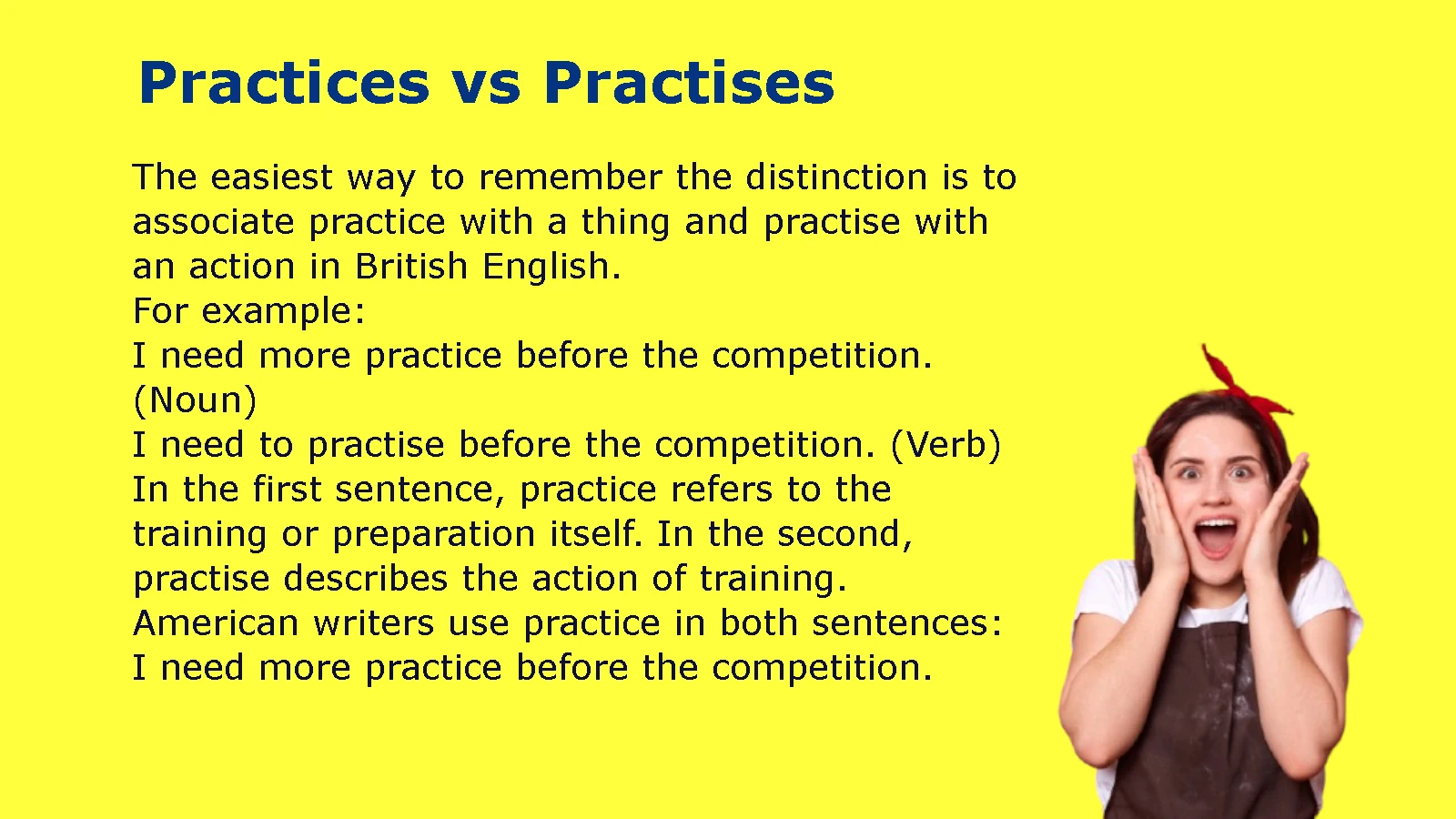
The easiest way to remember the distinction is to associate practice with a thing and practise with an action in British English.
For example:
- I need more practice before the competition. (Noun)
- I need to practise before the competition. (Verb)
In the first sentence, practice refers to the training or preparation itself. In the second, practise describes the action of training.
American writers use practice in both sentences:
- I need more practice before the competition.
- I need to practice before the competition.
This difference matters when you edit documents for a specific audience. A British publication generally expects the C/S distinction, while an American publication expects practice throughout.
Is It Practices or Practises?
Both practices and practises are correct spellings, but they have different grammatical roles in British English.
Practices is the plural form of the noun practice. Practises is the third-person singular form of the verb practise.
Compare these examples:
| Sentence | Correct word | Explanation |
| The company follows ethical practices. | Practices | Plural noun |
| She practises meditation daily. | Practises | Third-person singular verb |
| Several medical practices operate nearby. | Practices | Plural noun |
| He practises his presentation every morning. | Practises | Third-person singular verb |
In American English, both noun and verb forms use practices:
- The company follows ethical practices.
- She practices meditation daily.
The surrounding words help you identify the correct form. If the word names methods or activities, use practices. If it describes what someone does, British English uses practises.
Practice vs Practise in British and American English
British and American English follow different spelling conventions for this word pair. British English distinguishes between the noun and verb, while American English uses practice for both. This distinction also affects related forms such as practising, practised, and practiced.
Understanding the regional difference prevents inconsistent spelling, especially when writing for an international audience.
Practice or Practise in UK English
In British English, practice is always the noun, while practise is the verb.
This rule applies whether you are discussing education, sports, healthcare, music, or professional activities.
Examples of British English usage:
- Daily practice improves your communication skills.
- She practises speaking French with her classmates.
- The doctor opened a private medical practice.
- He practises law in London.
- Good study practices help students prepare for examinations.
- My brother practises football three times a week.
The distinction also applies to different verb forms.
| Grammatical form | British English | Example |
| Base verb | Practise | I practise every day. |
| Third-person singular | Practises | She practises every day. |
| Past tense | Practised | He practised yesterday. |
| Present participle | Practising | They are practising now. |
| Noun | Practice | Practice takes patience. |
| Plural noun | Practices | These practices are effective. |
A useful detail: British English retains the letter S in the verb forms, including practises, practised, and practising.
Practice or Practise in American English
American English uses practice as both a noun and a verb. Writers do not switch to practise when describing an action.
Examples:
- I practice basketball after school.
- She practices the violin every afternoon.
- They practice speaking English together.
- He practiced his speech before the meeting.
- We are practicing for the competition.
The related forms follow the American spelling convention:
| Grammatical form | American English | Example |
| Base verb | Practice | I practice daily. |
| Third-person singular | Practices | She practices daily. |
| Past tense | Practiced | He practiced yesterday. |
| Present participle | Practicing | They are practicing now. |
| Noun | Practice | Practice takes patience. |
| Plural noun | Practices | These practices are effective. |
The most important point is consistency. If your article targets American readers, use American spelling throughout. If it targets British readers, follow the British noun-and-verb distinction.
Why Do British and American English Spell These Words Differently?
The difference comes from the spelling conventions that developed in British and American English. British English preserves a distinction between certain noun and verb endings, while American English often uses one spelling for both.
The practice/practise distinction resembles other English word pairs, although each pair has its own rules.
| British English | American English | Usage |
| Practice / Practise | Practice | Noun / verb |
| Licence / License | License | Noun / verb |
| Advice / Advise | Advice / Advise | Noun / verb |
| Defence / Defense | Defense | Noun |
| Offence / Offense | Offense | Noun |
One important difference is that advice and advise retain their different spellings in both British and American English. Therefore, you should learn each spelling pattern rather than assume every noun-and-verb pair works identically.
Practice Meaning: What Does Practice Mean?
Practice is a noun that refers to the repeated performance of an activity, a learned skill, a customary method, or a professional business. It can describe training, experience, established behavior, or the work carried out by someone in a particular profession.
The word has several meanings depending on its context. Understanding these meanings helps you use practice naturally in sentences.
Practice as a Noun
As a noun, practice describes an activity or process that someone performs regularly. It can also refer to a method, routine, or professional service.
Here are its main meanings:
| Meaning | Explanation | Example |
| Repeated training | Performing an activity to improve a skill | Piano practice takes patience. |
| Habit or routine | Something someone regularly does | Reading before bed is a healthy practice. |
| Established method | A customary or accepted way of doing something | The company follows safe working practices. |
| Professional business | A business operated by a professional | She owns a dental practice. |
| Real-world application | Using knowledge or skills in actual situations | The course combines theory with practice. |
Consider how the meaning changes in these sentences:
- Music: Daily practice helps musicians develop better timing and technique.
- Education: Regular writing practice improves grammar and vocabulary.
- Medicine: The doctor manages a busy medical practice.
- Business: Transparent communication is a good business practice.
- Sports: The players attended football practice before the match.
Although these examples describe different activities, practice remains a noun in every sentence.
Practice as a Verb in American English
In American English, practice also works as a verb. It describes performing an activity repeatedly to develop ability, maintain proficiency, or prepare for a particular task.
For example:
- I practice English for 30 minutes every morning.
- She practices yoga before going to work.
- The students practice their presentations before the competition.
- He practices the guitar whenever he has free time.
- Our team practices every Saturday.
The verb can also describe professional work.
For example:
- She practices medicine in New York.
- He practices corporate law.
- The dentist has practiced for more than 15 years.
In these sentences, practice does not refer to training. It describes carrying out a profession.
This is an important distinction because the word can describe both repeated learning and professional activity.
Practise as a Verb in British English
British English uses practise as the verb equivalent of the American practice.
It describes actions such as training, rehearsing, developing a skill, and carrying out professional duties.
Examples include:
- I practise English with my colleagues.
- She practises the violin after school.
- They practise their speeches before important meetings.
- He practises medicine in Manchester.
- My sister practises yoga every morning.
The word also appears in different verb forms:
- Practise: I practise writing every day.
- Practises: She practises writing every day.
- Practised: He practised for the examination.
- Practising: They are practising for the performance.
Remember that the noun remains practice, even when it appears beside a British English verb.
For example:
“She needs more practice because she does not practise regularly.”
Both spellings are correct because they perform different grammatical functions.
Practice vs Practise Examples in Everyday Sentences
The easiest way to understand practice vs practise is to examine original sentences in different contexts. The noun identifies an activity, method, or professional establishment, while the British English verb describes the action of performing or developing a skill.
The following examples demonstrate how the distinction works in everyday communication.
Practice as a Noun: Example Sentences
Use practice when you refer to an activity, routine, method, or professional service.
| Example sentence | Context |
| Daily practice makes a noticeable difference in performance. | Skill development |
| My piano practice usually lasts an hour. | Music |
| The teacher introduced a new classroom practice. | Education |
| Regular reading practice improves vocabulary. | Learning |
| The hospital follows strict hygiene practices. | Healthcare |
| Good financial practices help businesses manage expenses. | Business |
| The football team has practice tomorrow. | Sports |
| The lawyer recently opened her own practice. | Profession |
| Meditation is a useful practice for managing daily stress. | Personal routine |
| Consistent safety practices reduce workplace risks. | Workplace |
In each sentence, practice or practices names something rather than describing an action.
Practise as a Verb: Example Sentences
Use practise when writing in British English and describing an action.
| British English sentence | American English equivalent |
| I practise speaking English. | I practice speaking English. |
| She practises the piano daily. | She practices the piano daily. |
| He practises law in London. | He practices law in London. |
| They practise football after school. | They practice football after school. |
| My daughter practises her spelling. | My daughter practices her spelling. |
| We practise meditation every morning. | We practice meditation every morning. |
| The students practise their presentations. | The students practice their presentations. |
| He practises driving before his test. | He practices driving before his test. |
These examples demonstrate why regional spelling matters. The meaning does not change when you switch between British and American English.
Practices vs Practises in Sentences
The difference between practices and practises becomes especially important when you write about multiple activities or describe what someone does.
Compare these examples:
British English:
- The school follows several effective teaching practices.
- The teacher practises new teaching techniques.
- Local medical practices offer different services.
- She practises medicine in a private clinic.
American English:
- The school follows several effective teaching practices.
- The teacher practices new teaching techniques.
- Local medical practices offer different services.
- She practices medicine in a private clinic.
A useful grammatical test is to replace the word with another noun or verb.
For example:
- “The company follows good practices.” You can replace practices with methods.
- “She practises every day.” You can replace practises with trains.
This simple test helps you identify the intended grammatical function.
Best Practice or Practise: Which Is Correct?
Best practice is the correct expression in both British and American English. The word practice functions as a noun, describing an effective, reliable, or widely accepted way to perform a task. The plural form, best practices, refers to multiple recommended methods or procedures.
The expression appears frequently in business, healthcare, education, technology, and professional development.
Best Practice vs Best Practise Examples
Always write best practice, not best practise, when referring to an established method or recommended approach.
Here are some original examples:
- Regularly updating passwords is a recommended security best practice.
- Clear communication is an important workplace best practice.
- Teachers should follow effective classroom best practices.
- Backing up important files is a sensible data-management best practice.
- Businesses should establish best practices for customer support.
The reason is grammatical: best describes practice, which remains a noun.
Even British English uses practice in this expression.
Best Practices in Business, Education, and Technology
The phrase best practices refers to methods that organizations or professionals consider effective based on experience, evidence, standards, or established procedures.
Its meaning can vary depending on the industry.
| Industry | Example of a best practice | Why it matters |
| Business | Documenting important procedures | Improves consistency |
| Education | Giving students regular feedback | Supports learning |
| Healthcare | Following infection-control procedures | Protects patients and staff |
| Technology | Testing software before release | Reduces errors |
| Finance | Maintaining accurate financial records | Supports accountability |
| Customer service | Responding to complaints promptly | Builds customer trust |
One important distinction: a best practice is not automatically a legal requirement. It describes a recommended approach, while regulations and formal standards may impose specific obligations.
For professional writing, use best practice when referring to one recommended method and best practices when referring to several.
Fitness to Practice or Practise: Which Spelling Is Correct?
Fitness to practise is the standard expression in British English when discussing whether someone has the competence, health, professional conduct, and suitability required to perform their professional duties. American English generally uses fitness to practice. The spelling depends on the regional convention.
This phrase appears frequently in healthcare regulation, professional education, licensing discussions, and employment policies.
Fitness to Practise in British English
In British English, fitness to practise describes whether a professional can perform their duties safely and competently.
The expression is particularly common in regulated professions, including:
- Medicine
- Nursing
- Dentistry
- Pharmacy
- Social work
- Other regulated healthcare professions
For example:
- The medical regulator investigated concerns about the doctor’s fitness to practise.
- Students must demonstrate their fitness to practise before entering certain professional roles.
- The professional body reviewed the nurse’s conduct and fitness to practise.
- Employers must address serious concerns that could affect an employee’s professional fitness to practise.
The grammatical explanation is straightforward. The phrase contains the infinitive marker “to,” followed by a verb. British English therefore uses practise.
However, the noun practice remains correct in expressions such as professional practice, medical practice, and clinical practice.
Fitness to Practice in American English
American English generally uses fitness to practice because practice functions as both a noun and a verb.
Examples:
- The licensing authority reviewed the physician’s fitness to practice.
- Professional training helps students develop the skills required for clinical practice.
- The organization evaluates whether applicants meet its professional standards.
The spelling differs, but the underlying meaning remains similar.
Why Is Fitness to Practise Common in the UK?
The expression follows the British noun-and-verb spelling distinction.
Consider these related sentences:
- Her professional practice meets the required standards. (Noun)
- She must demonstrate that she is fit to practise. (Verb)
The first sentence describes professional work. The second describes the ability to perform professional duties.
Practical writing tip: If you are preparing a document for a British professional regulator, university, or healthcare organization, check its preferred terminology. Established regulatory expressions may have precise wording that you should preserve.
Practice Questions or Practise Questions: Which One Is Correct?
Practice questions is the correct expression in both British and American English. The expression refers to exercises designed to help students develop knowledge, test their understanding, and prepare for examinations.
The spelling does not change in British English because practice remains a noun.
Practice Questions Meaning
Practice questions are exercises that help learners understand a subject, identify knowledge gaps, and prepare for assessments.
Students use them to test their understanding before taking actual examinations.
For example:
- The teacher gave us ten practice questions before the mathematics test.
- I completed several grammar practice questions to improve my writing.
- These science practice questions cover the most important topics.
- The website offers free English practice questions for beginners.
The phrase can refer to multiple types of learning activities, including multiple-choice questions, short-answer exercises, calculations, and essay prompts.
Practice Questions in School and Exam Preparation
Practice questions play an important role in structured learning.
Students can use them to:
- Identify topics they do not understand.
- Improve accuracy when answering questions.
- Become familiar with examination formats.
- Develop time-management skills.
- Review important concepts.
- Recognize recurring mistakes.
For example, a student preparing for a mathematics examination might complete practice questions on algebra, geometry, and percentages.
A language learner might answer grammar questions involving tenses, punctuation, vocabulary, and sentence structure.
The purpose is not simply to complete more exercises. Students should review incorrect answers and understand why they made mistakes.
Practice Question vs Practise Question
The correct expression is practice question, regardless of whether you follow British or American English.
| Expression | Correct? | Explanation |
| Practice question | Correct | Practice is a noun modifier. |
| Practise question | Incorrect | Practise is a verb in British English. |
| Practice questions | Correct | Plural noun phrase. |
| Practise questions | Incorrect | Incorrect spelling for this expression. |
The same principle applies to several other expressions:
- Practice test
- Practice exam
- Practice paper
- Practice exercise
- Practice session
- Practice worksheet
Use practice in these expressions because it functions as a noun.
Practice vs Practise Pronunciation: Do They Sound Different?
Practice and practise have the same pronunciation in standard English. Both are pronounced /ˈpræk.tɪs/, with the stress on the first syllable. Their difference exists in written English, not spoken English, so listeners rely on sentence context to understand their grammatical function.
How to Pronounce Practice and Practise
Both words contain two syllables and have the same vowel and consonant sounds.
Pronunciation guide
| Feature | Practice | Practise |
| IPA | /ˈpræk.tɪs/ | /ˈpræk.tɪs/ |
| Syllables | 2 | 2 |
| Stress | First syllable | First syllable |
| Sound | Identical | Identical |
To pronounce both words correctly:
- Start with the consonant sound /p/.
- Follow it with the short vowel sound /æ/.
- Pronounce the /k/ sound clearly.
- Finish with the unstressed second syllable.
The first syllable receives the strongest emphasis.
Are Practice and Practise Homophones?
Yes. Practice and practise are homophones because they share the same pronunciation but have different spellings and grammatical functions.
Other English homophones include:
- Right and write: Both sound identical but have different meanings.
- Their and there: Both share the same pronunciation but serve different grammatical purposes.
- Peace and piece: Both sound the same despite their different meanings.
- Advice and advise: These words have different pronunciations, so they are not homophones.
For practice and practise, the surrounding sentence usually makes the intended meaning clear.
For example:
“She needs more practice because she wants to practise regularly.”
Although both words sound identical, their grammatical roles differ.
Practice vs Practise: Similar Words and Related Spelling Rules
Practice and practise have several related words, including training, rehearsal, exercise, preparation, and repetition. However, these terms do not always mean exactly the same thing. Choosing the right alternative depends on whether you describe learning, performing, developing a skill, or following an established method.
Understanding related spelling patterns also helps you avoid other common English grammar mistakes.
Advice vs Advise
Advice is a noun, while advise is a verb in both British and American English.
| Word | Part of speech | Example |
| Advice | Noun | My teacher gave me useful advice. |
| Advise | Verb | I advise you to review your notes. |
The spelling difference resembles the British practice/practise distinction.
A useful memory technique is to associate the C in practice with the C in advice. Similarly, the S in practise resembles the S in advise.
However, remember that advice and advise retain their respective spellings in American English too.
Device vs Devise
Device is a noun that describes a tool, machine, or piece of equipment. Devise is a verb that means to create or develop a plan or solution.
Examples:
- My phone is a useful electronic device.
- The team will devise a new marketing strategy.
- This security device protects the building.
- Engineers devise solutions to technical problems.
The difference depends on grammatical function, not regional spelling.
Licence vs License
This pair follows a related British and American spelling convention.
In British English:
- Licence is the noun.
- License is the verb.
In American English, license serves as both the noun and verb.
| Meaning | British English | American English |
| Driving permission (noun) | Licence | License |
| Permission granted (verb) | License | License |
| Professional authorization (noun) | Licence | License |
Examples:
- She applied for a driving licence. (British English)
- The authority will license the business. (British English)
- She applied for a driving license. (American English)
This comparison reinforces the importance of identifying the part of speech before selecting a spelling.
Other Words Related to Practice and Practise
Several words can replace practice or practise in certain contexts. However, no synonym works perfectly in every sentence.
| Related word | Meaning | Example |
| Training | Learning or developing a skill | The team completed additional training. |
| Rehearsal | Preparing for a performance | The actors attended a rehearsal. |
| Exercise | An activity designed to develop ability | The students completed a grammar exercise. |
| Preparation | Getting ready for a task | Proper preparation improves confidence. |
| Repetition | Doing something again | Repetition helps reinforce learning. |
| Application | Putting knowledge into practical use | The course encourages practical application. |
| Performance | Carrying out an activity | Her performance improved considerably. |
| Routine | A regular sequence of activities | Morning exercise is part of his routine. |
| Proficiency | A high level of skill | Regular study improves language proficiency. |
| Experience | Knowledge gained through involvement | Practical experience helps new employees. |
Choose synonyms according to context.
For example, training works well when describing structured learning, while rehearsal suits preparation for a performance. Repetition emphasizes doing something repeatedly, whereas application describes using knowledge in a real situation.
Common Mistakes When Using Practice and Practise
Writers often confuse practice and practise because the two words sound identical. The most common mistakes involve using the verb spelling as a noun, using the noun spelling as a British English verb, and mixing British and American conventions within the same document.
Here are the errors worth checking.
Using Practise as a Noun
In British English, practise cannot function as a noun.
Incorrect: Regular practise improves your writing.
Correct: Regular practice improves your writing.
The word describes an activity, so you need the noun spelling.
Another example:
Incorrect: The school introduced new teaching practises.
Correct: The school introduced new teaching practices.
The plural noun always uses practices.
Using Practice as a Verb in British English
British English requires practise when describing an action.
Incorrect: I practice the piano every evening.
Correct: I practise the piano every evening.
Another example:
Incorrect: She practices speaking French.
Correct: She practises speaking French.
However, these sentences are perfectly correct in American English. Always consider your intended audience before marking a spelling as incorrect.
Confusing Practices and Practises
These words can create confusion because both end in S.
Compare:
- The company follows ethical practices.
- The company practises ethical leadership.
The first sentence uses a plural noun. The second uses a third-person singular verb in British English.
A quick grammatical check usually solves the problem:
- Can you replace the word with methods? Use practices.
- Can you replace it with performs or carries out? Use practises in British English.
Mixing British and American English
Another common problem occurs when writers switch spelling conventions without realizing it.
For example:
“She practices the piano every evening, and her daily practise has improved her performance.”
This sentence mixes American verb spelling with British noun-and-verb conventions.
Choose one regional standard instead.
British English:
“She practises the piano every evening, and her daily practice has improved her performance.”
American English:
“She practices the piano every evening, and her daily practice has improved her performance.”
Consistency makes professional writing easier to read and edit.
How to Remember the Difference Between Practice and Practise
You can remember the British English distinction by connecting the letter C with nouns and the letter S with verbs. Practice is the noun, while practise is the verb. American English uses practice for both, so the memory trick applies specifically to British spelling.
The Ice and Advise Memory Trick
A useful way to remember the distinction is to compare:
- Advice: Noun
- Advise: Verb
- Practice: Noun
- Practise: Verb
Think of the C in practice as the C in advice. Both words function as nouns.
Similarly, connect the S in practise with the S in advise. Both function as verbs.
This pattern gives you a quick reference when writing British English.
However, do not apply it to every noun-and-verb pair in English. Some words follow different spelling rules.
A Quick Decision-Making Checklist
Before choosing between practice and practise, ask yourself these questions:
- Are you naming an activity or method? Use practice.
- Are you describing repeated training or performing an action in British English? Use practise.
- Are you writing in American English? Use practice for both nouns and verbs.
- Are you using an expression such as best practice? Use practice.
- Are you writing practice questions or practice tests? Use practice because it functions as a noun modifier.
Here is a simple example that combines several rules:
“She practises every morning because regular practice helps her improve.”
The first word describes an action. The second names the activity.
A Practical Editing Case Study
Imagine that a British English teacher is reviewing a student’s paragraph:
“Regular practise is important for learning a language. Students should practice speaking every day, complete practise questions, and follow the best practise methods.”
The paragraph contains three spelling mistakes under standard British English conventions.
The corrected version is:
“Regular practice is important for learning a language. Students should practise speaking every day, complete practice questions, and follow the best practice methods.”
Here is why each correction works:
| Original wording | Correct wording | Reason |
| Regular practise | Regular practice | Noun |
| Should practice | Should practise | Verb |
| Practise questions | Practice questions | Noun modifier |
| Best practise methods | Best practice methods | Noun |
This example shows why memorizing one general rule is not enough. You must identify how the word functions in each sentence.
A useful editing habit is to review every occurrence of practice and practise separately rather than relying only on spell-checking software.
Frequently Asked Questions
Is It Practices or Practises?
Both spellings are correct, but they have different grammatical functions in British English. Practices is the plural form of the noun practice, while practises is the third-person singular form of the verb practise.
Examples:
- The organization follows responsible business practices.
- She practises the piano every afternoon.
American English uses practices for both forms.
Is Practice or Practise Correct in UK English?
Both are correct in British English, but you must use them in different situations. Practice is the noun, while practise is the verb.
For example:
- Regular practice improves performance.
- He practises football every weekend.
This distinction applies to other verb forms, including practised and practising.
Is It Best Practice or Best Practise?
Best practice is correct in both British and American English. Practice functions as a noun that describes an effective or recommended method.
For example:
“Keeping customer information secure is a business best practice.”
The spelling does not change in British English because the expression uses a noun.
Is It Fitness to Practice or Fitness to Practise?
Fitness to practise is the standard British English expression, while fitness to practice is the American English form.
The phrase describes someone’s suitability and ability to perform professional duties competently and safely.
It commonly appears in healthcare regulation and other professional settings.
Is It Practice Questions or Practise Questions?
Practice questions is correct in both British and American English.
Practice functions as a noun modifying questions. The expression refers to exercises that help students prepare for examinations and strengthen their understanding.
For example:
“Complete these practice questions before your mathematics examination.”
Do Practice and Practise Have the Same Pronunciation?
Yes. Both words have the same standard pronunciation: /ˈpræk.tɪs/.
They contain two syllables and receive stress on the first syllable. Their difference concerns spelling and grammatical function rather than pronunciation.
Conclusion: Practice vs Practise
The difference between practice and practise comes down to grammar and regional spelling conventions.
In British English, practice is a noun, while practise is a verb. American English uses practice for both grammatical functions.
Remember these essential rules:
- Use practice when referring to an activity, method, habit, or professional establishment.
- Use practise when describing an action in British English.
- Use practices as the plural noun.
- Use practises as the third-person singular British English verb.
- Write best practice, practice questions, and fitness to practise when following the relevant British conventions.
- Keep your spelling consistent throughout your writing.
The easiest way to avoid mistakes is to identify whether the word functions as a noun or verb before choosing its spelling.