A plow and a plough refer to the same agricultural tool used to break up, turn, and prepare soil for planting. If you’ve come across “plow” and “plough” and wondered which spelling is correct, the difference is mainly based on American and British English. Both forms are standard, but they are used in different varieties of English.
The plow vs plough distinction is straightforward: plow is the preferred spelling in American English, while plough is more common in British English and other varieties influenced by British usage. The words have the same meaning and pronunciation, and the same distinction appears in related forms such as plowed/ploughed and plowing/ploughing.
In this guide, you’ll learn whether “plow” or “plough” is correct, the difference between the two spellings, how each is used in American and British English, and how to choose the right form in your writing. You’ll also see clear examples, related word forms, and common usage patterns to make the distinction easy to remember.
By the end, you’ll know exactly when to use plow and when to use plough and how to use both spellings naturally and correctly.
Quick Answer: Plow or Plough?
Plow and plough are both correct.
| Question | Answer |
| Is plow correct? | Yes. It is the usual American English spelling. |
| Is plough correct? | Yes. It is the usual British English spelling. |
| Do they have the same meaning? | Yes. |
| Are they pronounced the same? | Yes, in standard usage. |
| Which spelling should Americans use? | Plow |
| Which spelling should British writers use? | Plough |
| What about Canadian, Australian, and other varieties? | Usage can vary, but plough is common in British-influenced varieties. |
| Is snowplow correct? | Yes, especially in American English. |
| Is snowplough correct? | Yes, especially in British English. |
Cambridge identifies plow as the U.S. spelling of plough, while Oxford labels plow as North American English and plough as British English.
So, if you are writing for a U.S. audience, choose plow. If you are following British English conventions, choose plough.
What Does Plow Mean?
Plow is both a noun and a verb.
As a noun, a plow is a large agricultural implement with blades or other cutting parts that digs into and turns over soil. Traditionally, plows could be pulled by animals. Modern versions are commonly attached to tractors.
As a verb, to plow means to work or turn over soil with a plow. The word can also describe clearing snow or moving forcefully through something.
For example:
- The farmer used a plow to prepare the field.
- The tractor plowed the soil before planting.
- Workers plowed the road after the snowstorm.
- The truck plowed through the barrier.
The basic agricultural sense is the oldest and provides the foundation for many of the word’s figurative meanings.
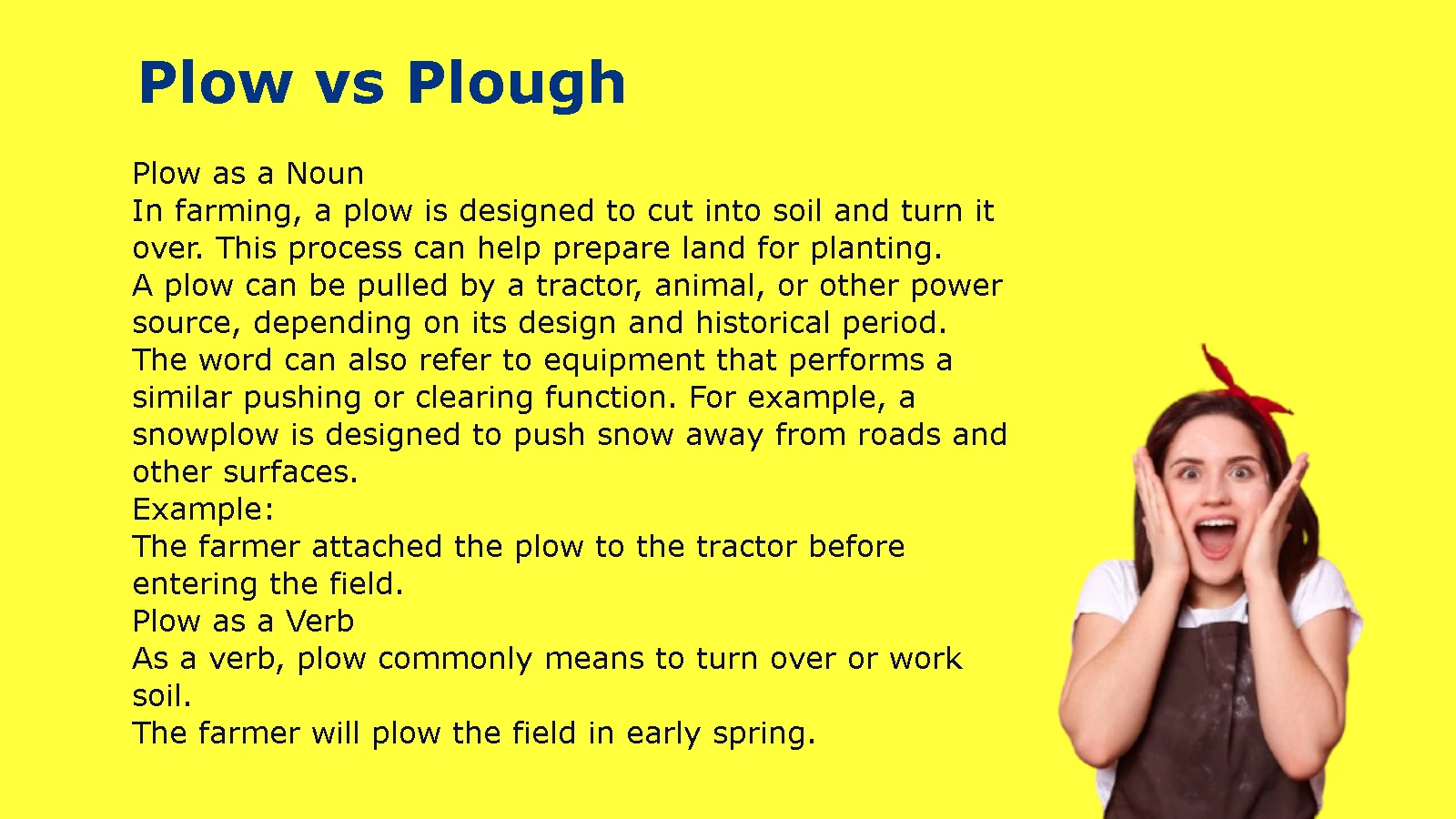
Plow as a Noun
In farming, a plow is designed to cut into soil and turn it over. This process can help prepare land for planting.
A plow can be pulled by a tractor, animal, or other power source, depending on its design and historical period.
The word can also refer to equipment that performs a similar pushing or clearing function. For example, a snowplow is designed to push snow away from roads and other surfaces.
Example:
The farmer attached the plow to the tractor before entering the field.
Plow as a Verb
As a verb, plow commonly means to turn over or work soil.
The farmer will plow the field in early spring.
It can also mean to clear snow:
The city crews began to plow the roads after the storm.
A broader figurative sense describes moving through something with force or difficulty:
She plowed through the report before the meeting.
Cambridge and Oxford both recognize these extended uses of the verb.
What Does Plough Mean?
Plough has the same basic meanings as plow. The difference is spelling rather than meaning.
In British English, a plough is a farming implement used to dig into and turn over soil. As a verb, plough means to work the soil with a plough.
Examples include:
- The farmer repaired the plough before the harvest season.
- The fields were ploughed before planting.
- The tractor ploughed through the wet ground.
- The council sent a vehicle to plough the snow-covered roads.
Oxford lists plough as the British English form and plow as its North American equivalent.
Plough as a Noun
A plough is traditionally a tool with one or more curved blades that cuts into and turns over soil.
The old plough was pulled by a team of oxen.
The noun can also occur in specialized contexts. For example, British English commonly uses snowplough for equipment or vehicles designed to clear snow.
Plough as a Verb
The verb plough describes the action of working soil with a plough.
The farmer ploughed the field before planting wheat.
It also appears in figurative expressions.
She ploughed through hundreds of pages of research.
The British spelling therefore extends consistently to related forms such as ploughed and ploughing. Oxford lists these as the British verb forms.
Plow vs Plough: What Is the Difference?
The simplest answer is that plow vs plough is primarily a spelling difference based on regional English.
| American English | British English |
| plow | plough |
| plowed | ploughed |
| plowing | ploughing |
| plows | ploughs |
| snowplow | snowplough |
| plow through | plough through |
| plow into | plough into |
| plow on | plough on |
The meanings remain substantially the same.
This is similar to other American and British spelling differences such as color/colour, labor/labour, and center/centre. The spelling signals the variety of English being used, but it does not normally create a different definition.
Cambridge explicitly marks plow as the U.S. spelling of plough, while Oxford uses regional labels to distinguish the two forms.
Plow or Plough: Which Spelling Is Correct?
There is no single spelling that is correct for every English-speaking audience.
The better choice depends on your intended form of English.
Use Plow in American English
Use plow when writing in standard American English.
Examples:
- The farmer plowed the field.
- The city sent out snowplows.
- We need to plow the driveway.
- He plowed through the paperwork.
American dictionaries recognize plow as the American form.
Use Plough in British English
Use plough when following standard British English conventions.
Examples:
- The farmer ploughed the field.
- The council sent out snowploughs.
- The road was ploughed after the snowfall.
- She ploughed through the report.
Oxford and Cambridge both identify plough as the British form.
What If You Are Writing for an International Audience?
Choose one spelling system and use it consistently.
For example, an article written in American English should generally use:
The farmer plowed the field and later used a snowplow to clear the road.
A British English version would use:
The farmer ploughed the field and later used a snowplough to clear the road.
Mixing the systems unnecessarily can make the writing look inconsistent.
American English vs British English
The plow vs plough distinction is a straightforward example of regional spelling.
Plow in American English
American English generally prefers the shorter plow spelling.
This applies not only to the base word but also to several derived forms:
- plow
- plows
- plowed
- plowing
- plowman
- snowplow
- plowshare
American dictionaries also recognize some British-style forms as variants in particular contexts, but plow is the normal American spelling.
Plough in British English
British English generally retains the -ough spelling:
- plough
- ploughs
- ploughed
- ploughing
- ploughman
- snowplough
- ploughshare
Oxford specifically lists ploughed as the past tense and ploughing as the -ing form of the British verb.
The important point is consistency. If the surrounding article follows British spelling, plough will usually fit better. If it follows American spelling, plow is the natural choice.
Plow vs Plough Pronunciation
One of the easiest parts of the comparison is pronunciation: plow and plough are pronounced the same in standard English.
The pronunciation is represented by the IPA form /plaʊ/ in dictionaries such as Oxford and Cambridge.
The spelling may look dramatically different, but the pronunciation does not change simply because the word gains the letters gh.
That makes plow vs plough different from spelling pairs where pronunciation changes along with spelling.
Why Does Plough Have Extra Letters?
The gh reflects historical spelling rather than a modern pronunciation difference.
Oxford traces the word to late Old English plōh, from Germanic origins, and notes that the spelling plough became common in England in the 18th century.
The historical development helps explain why modern English can contain a silent gh in this word.
Plow and Plough as Nouns
Both forms can refer to the same agricultural tool.
| Meaning | American English | British English |
| Farming implement | plow | plough |
| Tool used to turn soil | plow | plough |
| Snow-clearing device | snowplow | snowplough |
| Figurative reference to a forceful tool/device | plow | plough |
Examples With Plow
- The plow cut deep furrows into the soil.
- The tractor pulled a heavy plow.
- The farmer bought a new plow for the field.
- A snowplow cleared the highway.
Examples With Plough
- The plough cut deep furrows into the soil.
- The tractor pulled a heavy plough.
- The farmer repaired the old plough.
- A snowplough cleared the road.
Oxford defines the noun as a large piece of farming equipment with curved blades used for digging and turning over soil.
Plow and Plough as Verbs
Both words also work as verbs.
The agricultural meaning is straightforward: the action involves turning over or working the soil.
American English Examples
The farmer plowed the field before planting.
They are plowing the land this week.
The tractor plowed several acres yesterday.
British English Examples
The farmer ploughed the field before planting.
They are ploughing the land this week.
The tractor ploughed several acres yesterday.
Oxford gives the American verb forms as plow, plows, plowed, plowing and the British forms as plough, ploughs, ploughed, ploughing.
Plow vs Plough in Common Expressions
The spelling difference continues into expressions built from the word.
Plow Through / Plough Through
Plow through is the American form, while plough through is the British form.
The expression can describe physically forcing your way through something or working through a large, difficult, or tedious task.
For example:
I had to plow through several reports before the meeting.
British English would normally write:
I had to plough through several reports before the meeting.
Cambridge defines the expression as going through something with difficulty and also uses it for finishing something such as reading, eating, or dealing with a large amount of material.
Oxford similarly gives meanings including forcing a way through something and making slow progress through something difficult or boring.
Plow Ahead / Plough Ahead
Plow ahead means to continue with something despite difficulties or obstacles.
The British equivalent is plough ahead.
Examples:
Despite the delays, the company decided to plow ahead with the project.
Despite the delays, the company decided to plough ahead with the project.
The spelling changes, but the underlying expression remains the same.
Plow Into / Plough Into
Plow into can mean to hit something with force.
The truck plowed into the barrier.
It can also be used figuratively when someone puts substantial effort or resources into something.
She plowed money into the business.
British English uses plough into in the same types of constructions.
Dictionary.com traces the forceful sense of plow into to the physical action of a plow moving into something.
Plow Back / Plough Back
In financial and business contexts, plow back can mean to reinvest money or profits into a business.
For example:
The company plans to plow back its profits into research.
British English uses plough back.
The figurative meaning comes naturally from the agricultural image: resources are put back into the ground so that they can produce something later.
Snow Plow or Snow Plough?
If you searched for snow plow vs snow plough, you are dealing with the same regional spelling distinction.
Snowplow is the standard American form, while snowplough is the standard British form. Collins explicitly identifies snowplough as the British form and snowplow as the American form.
A snowplow can refer to a vehicle, machine, or blade used to push snow away from roads and other surfaces.
American English
The snowplow cleared the highway overnight.
British English
The snowplough cleared the road overnight.
Both describe essentially the same equipment.
The word can also have a skiing meaning. In skiing, a snowplow or snowplough can describe a technique in which the skis point inward to help a skier control speed or stop.
Snow Plow or Snowplow?
There is another small distinction worth knowing.
Snowplow is commonly written as one word in American English. You may also encounter snow plow in some writing, but snowplow is an established dictionary form. American Heritage and Cambridge both list snowplow as a noun.
In British English, snowplough is the established corresponding form.
Plow vs Plough in Different Contexts
The following table makes the regional difference easy to see:
| Context | American English | British English |
| Farming | plow | plough |
| Turning soil | plow the field | plough the field |
| Past tense | plowed | ploughed |
| -ing form | plowing | ploughing |
| Snow removal | snowplow | snowplough |
| Moving through something | plow through | plough through |
| Continuing despite difficulty | plow on | plough on |
| Hitting something forcefully | plow into | plough into |
| Reinvesting money | plow back | plough back |
The difference is systematic enough that once you know which regional variety you are using, choosing the correct form becomes straightforward.
Common Mistakes With Plow and Plough
Assuming One Spelling Is Wrong
The most common mistake is believing that either plow or plough is inherently incorrect.
Neither is.
They represent established regional forms of the same word. Cambridge and Oxford both explicitly identify the American and British forms.
Mixing Regional Spellings
Another problem occurs when a document switches between American and British conventions without a reason.
For example:
The farmer plowed the field and later ploughed another section.
The sentence is understandable, but the spelling is inconsistent if the document is intended to follow one variety of English.
A cleaner American version is:
The farmer plowed the field and later plowed another section.
A cleaner British version is:
The farmer ploughed the field and later ploughed another section.
Assuming the Pronunciation Changes
The extra gh in plough does not create a different standard pronunciation.
Both forms are pronounced /plaʊ/.
Using Plough in American Copy Without a Reason
Plough can certainly be understood by American readers, but plow is the normal American spelling.
If you are writing a U.S.-focused article, product description, school assignment, or business document, plow will normally be the more natural choice.
Using Plow in British Copy Without Considering Style
The reverse applies to British English.
British readers are familiar with plow, but plough is the conventional British spelling.
How to Choose Between Plow and Plough
Use this simple rule:
Writing in American English? Use plow.
Writing in British English? Use plough.
The same principle applies to the related forms.
| If you are using… | Choose… |
| American English | plow |
| British English | plough |
| American English past tense | plowed |
| British English past tense | ploughed |
| American English -ing form | plowing |
| British English -ing form | ploughing |
| American snow-removal term | snowplow |
| British snow-removal term | snowplough |
For professional writing, consistency matters more than trying to make one spelling universally dominant.
A Simple Editing Test
If you are proofreading a document and find both forms, ask:
- Is the document written in American or British English?
- Which spelling does the publication or organization use?
- Do the related forms follow the same system?
- Are terms such as snowplow/snowplough consistent?
- Are expressions such as plow through/plough through consistent?
This approach prevents most spelling inconsistencies.
Plow vs Plough: Example Sentences
Here are examples showing how the two varieties work.
Farming
American English:
The farmer will plow the field before planting corn.
British English:
The farmer will plough the field before planting wheat.
Past Tense
American English:
The field was plowed in early spring.
British English:
The field was ploughed in early spring.
Snow Removal
American English:
The city sent a snowplow to clear the road.
British English:
The council sent a snowplough to clear the road.
Figurative Use
American English:
She had to plow through hundreds of pages.
British English:
She had to plough through hundreds of pages.
Forceful Movement
American English:
The vehicle plowed into the fence.
British English:
The vehicle ploughed into the fence.
These examples demonstrate an important point: the spelling changes, but the meaning and grammatical role remain essentially the same.
Plow vs Plough: Related Words
The regional distinction appears in several related words.
Plowed vs Ploughed
Plowed is the standard American past tense and past participle.
Ploughed is the standard British form.
American: The farmer plowed the field.
British: The farmer ploughed the field.
Oxford lists both sets of forms according to regional variety.
Plowing vs Ploughing
The same pattern applies to the present participle:
- American English: plowing
- British English: ploughing
The tractor is plowing the field.
The tractor is ploughing the field.
Plower vs Plougher
A person or machine that plows can be described with related forms such as plower and plougher. Collins notes plougher as the British-related form and plower as the corresponding U.S. form.
These forms are much less common in ordinary everyday writing than plow/plough themselves.
Is Plowed or Ploughed Correct?
Both are correct, but they belong to different regional spelling systems.
Plowed is standard American English.
Ploughed is standard British English.
Oxford lists the American verb forms as plow, plows, plowed, plowing and the British forms as plough, ploughs, ploughed, ploughing.
So:
American: The field was plowed.
British: The field was ploughed.
Neither sentence is wrong.
Is Plowing or Ploughing Correct?
Again, both are correct.
Use plowing in American English and ploughing in British English.
The difference is especially useful to remember because the -ing form does not simply add -ing to the two spellings in the same visual way.
| Base form | -ing form |
| plow | plowing |
| plough | ploughing |
Oxford gives plowing as the North American form and ploughing as the British form.
Plow vs Plough vs Plow Through
These terms are related, but they are not interchangeable in every sentence.
Plow or plough can refer directly to the agricultural tool or the act of working soil.
Plow through or plough through is a phrasal verb with a broader figurative meaning.
Compare:
The farmer plowed the field.
Here, plowed has the literal agricultural meaning.
I plowed through the report.
Here, plowed through means working through something difficult, lengthy, or tedious.
Oxford recognizes plow through as meaning to force a way through something or to make slow progress through difficult material.
The British equivalent is plough through.
The History Behind Plow and Plough
The two spellings have a long history.
Oxford traces plough to late Old English plōh and identifies it as a word of Germanic origin related to words such as Dutch ploeg and German Pflug. Oxford also notes that the spelling plough became common in England in the 18th century.
The history is more complicated than simply saying that one country invented one spelling and another country invented the other.
Earlier English records contain several forms, and spelling conventions changed over time. Etymonline traces plow to Old English forms such as plōh/plōg and related Germanic words.
The modern American plow and British plough therefore represent different developments and standardizations of an old English word rather than two unrelated words.
Interestingly, the spelling distinction also reflects a broader pattern in English: American English often simplified or shortened certain traditional spellings, while British English retained forms with historical letters.
A Note About the Plough and the Big Dipper
There is one additional meaning worth knowing.
In British English, the Plough can refer to a group of seven bright stars that North American English generally calls the Big Dipper. Oxford lists this as a separate noun sense.
So if you encounter the Plough in a British text, context matters.
For example:
The sailors navigated by the stars of the Plough.
Here, the word is not referring to agricultural equipment.
This astronomical use is distinct from the ordinary farming sense but comes from the same word.
Case Study: Choosing the Right Spelling in Real Writing
Imagine a U.S. agricultural equipment company creating a product page.
The page says:
Our heavy-duty plough is designed for large American farms. The machine can be ploughed through difficult soil.
The meaning is understandable, but the spelling does not match standard American usage.
A consistent American version would be:
Our heavy-duty plow is designed for large American farms. The machine can be plowed through difficult soil.
Now imagine a British agricultural publication.
Its natural version would be:
Our heavy-duty plough is designed for large British farms. The machine can be ploughed through difficult soil.
The lesson is simple: regional consistency improves naturalness and editorial accuracy.
The issue is not that one spelling has a better definition. The issue is matching the spelling to the variety of English being used.
Facts to Remember About Plow vs Plough
Here are the key facts in one place:
- Plow and plough are both correct English spellings.
- Plow is the standard American English form.
- Plough is the standard British English form.
- Both can function as a noun and a verb.
- Both refer to the same basic agricultural tool and action.
- Both are pronounced /plaʊ/ in standard dictionary representations.
- Plowed is the usual American past form.
- Ploughed is the usual British past form.
- Plowing is the usual American -ing form.
- Ploughing is the usual British -ing form.
- Snowplow is the American form.
- Snowplough is the British form.
- Plow through is American English.
- Plough through is British English.
- The spelling difference does not normally create a difference in meaning.
- The best spelling depends on the English variety used in the surrounding text.
Frequently Asked Questions
Is plow or plough correct?
Both are correct. Plow is the standard American English spelling, while plough is the standard British English spelling.
Is plough British or American?
Plough is primarily the British English spelling. North American English generally uses plow.
Is plow American or British?
Plow is primarily the American English spelling. British English generally uses plough.
Are plow and plough pronounced the same?
Yes. Standard dictionaries give the pronunciation as /plaʊ/ for both forms.
Is snow plow or snow plough correct?
Both are correct regionally. Snowplow is the American form, while snowplough is the British form.
What is the past tense of plow?
The standard American past tense is plowed.
The British equivalent is ploughed.
Is plowed or ploughed correct?
Both are correct. Use plowed in American English and ploughed in British English.
Is plowing or ploughing correct?
Both are correct. Plowing is the standard American form, while ploughing is the standard British form.
What does plow through mean?
Plow through can mean forcing your way through something or working through a large, difficult, or tedious task. For example, you can plow through a pile of paperwork. The British equivalent is plough through.
Can plow and plough be used interchangeably?
They can usually be substituted for each other when changing between American and British English, because they have the same basic meaning. However, you should maintain one regional spelling system within a document.
Conclusion
The difference between plow vs plough is mainly a matter of regional English spelling.
Use plow when writing in American English. Use plough when writing in British English. The same distinction carries over to related forms: plowed/ploughed, plowing/ploughing, and snowplow/snowplough.
Neither spelling is inherently more correct than the other. What matters is using the form that matches your intended variety of English and keeping that choice consistent.
If you are writing for an American audience, the simplest rule is:
American English → plow
For British English:
British English → plough
Once you understand that distinction, related expressions such as plow through, plough through, plow into, and plough into become much easier to use correctly.
For authoritative reference, dictionaries such as Cambridge Dictionary and Oxford Learner’s Dictionaries provide regional labels and usage information for these forms.