Have you ever wondered whether Pajamas vs Pyjamas is just a spelling preference or if one is actually correct? You’re not alone. Many writers, students, and English learners get confused because both spellings appear in books, websites, and everyday conversations.
Pajamas and pyjamas mean the same thing—they both refer to clothes worn for sleeping. The only difference is the spelling. Pajamas is the preferred spelling in American English, while pyjamas is the standard spelling in British English and many other English-speaking countries.
Examples:
- I bought new pajamas for the winter. (American English)
- She packed her pyjamas for the holiday. (British English)
The confusion often starts when people search for pajamas meaning, pyjamas meaning, pajamas pronunciation, or pyjamas pronunciation and find different answers depending on the region. But here’s the kicker: the choice between pajamas and pyjamas usually comes down to American vs British English, not grammar.
In this guide, you’ll learn the difference between Pajamas vs Pyjamas, discover the correct spelling for different English dialects, explore pajamas vs pyjamas examples, and find out when to use pajamas or pyjamas in writing. You’ll also learn how to pronounce pajamas, how to pronounce pyjamas, and why both spellings are accepted in modern English.
Quick Answer: Pajamas vs Pyjamas Difference
The main difference between pajamas and pyjamas is the type of English used.
| Word | English Variety | Meaning | Common Usage |
| Pajamas | American English | Clothing worn for sleeping or relaxing | United States and American based content |
| Pyjamas | British English | Clothing worn for sleeping or relaxing | United Kingdom, Australia, New Zealand, India, Pakistan, and other Commonwealth regions |
Simple explanation:
- Pajamas = American spelling
- Pyjamas = British spelling
- Both words mean the same thing
- Neither spelling is more correct than the other
Think of it like other spelling differences in English:
| American English | British English |
| Color | Colour |
| Center | Centre |
| Theater | Theatre |
| Pajamas | Pyjamas |
These differences developed because English changed differently in various parts of the world.
What Are Pajamas or Pyjamas?
Pajamas (or pyjamas) are loose, comfortable garments designed mainly for sleeping. They usually come as a matching set with a top and bottom, although modern styles now include many different designs.
Traditional pajamas typically include:
- A long sleeved or short sleeved shirt
- Loose fitting pants
- Soft fabrics such as cotton, silk, fleece, or linen
Today, pajamas come in many forms to match different preferences and climates.
Common types include:
| Type of Sleepwear | Description |
| Classic pajama set | A matching shirt and pants combination |
| Pajama shorts set | A lightweight option for warmer weather |
| Footed pajamas | One piece sleepwear that covers the feet |
| Lounge pajamas | Comfortable clothing used for relaxing at home |
| Flannel pajamas | Warm sleepwear often worn during colder months |
| Silk pajamas | Smooth, lightweight sleepwear associated with luxury |
Although people traditionally wore pajamas only at bedtime, their use has expanded.
Many people now wear pajamas for:
- Relaxing at home
- Watching movies
- Traveling comfortably
- Spending lazy weekends indoors
- Attending pajama themed parties
The modern idea of pajamas has moved beyond simple sleep clothing. They have become part of casual home fashion.
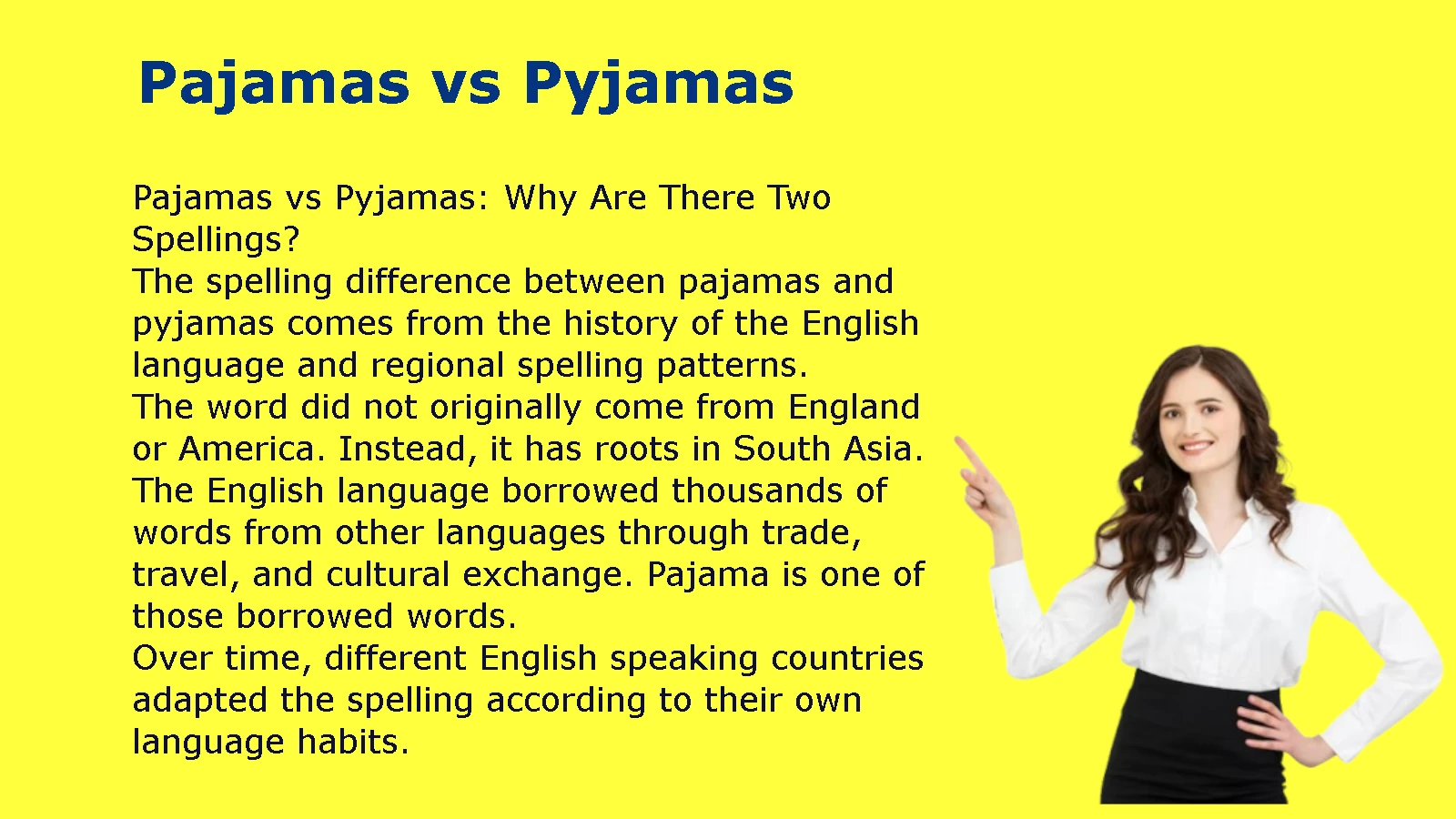
Pajamas vs Pyjamas: Why Are There Two Spellings?
The spelling difference between pajamas and pyjamas comes from the history of the English language and regional spelling patterns.
The word did not originally come from England or America. Instead, it has roots in South Asia.
The English language borrowed thousands of words from other languages through trade, travel, and cultural exchange. Pajama is one of those borrowed words.
Over time, different English speaking countries adapted the spelling according to their own language habits.
The Origin of the Word Pajama
The word pajama comes from the Hindi and Urdu word pajama, which referred to loose trousers worn on the legs.
The original word was connected to the Persian language:
- pāy = leg
- jāma = clothing or garment
Together, the word described a garment worn on the legs.
In South Asia, loose trousers were common clothing long before Western societies adopted the term.
British travelers and colonial officials encountered these garments during their time in India. They later brought the word into English.
At first, “pajamas” did not specifically mean sleepwear. It referred more broadly to loose trousers.
Over time, Western cultures adapted the clothing style and began using matching pajama sets as nighttime clothing.
How Did Pajamas Become Sleepwear?
The transition from everyday clothing to sleepwear happened gradually.
During the 1800s and early 1900s, Western societies began replacing older nighttime clothing styles with more comfortable alternatives.
Before modern pajamas became popular, many people wore:
- Long nightshirts
- Sleeping gowns
- Loose robes
Pajamas offered several advantages:
- They allowed easier movement.
- They felt more practical than long gowns.
- They provided warmth while sleeping.
- They looked more structured and fashionable.
By the early 20th century, pajama sets became common in Europe and North America.
Fashion designers also helped popularize them by creating versions made from:
- Cotton
- Satin
- Silk
- Flannel
Today, pajamas are a global clothing item worn by people of all ages.
Are Pajamas and Pyjamas the Same Thing?
Yes. Pajamas and pyjamas are exactly the same type of clothing.
The difference is only spelling.
Someone wearing pajamas in the United States is wearing the same kind of clothing as someone wearing pyjamas in the United Kingdom.
There is no difference in:
- Design
- Purpose
- Comfort
- Material
- Style
For example:
American English:
“My favorite pajamas are made from soft cotton.”
British English:
“My favorite pyjamas are made from soft cotton.”
Both sentences describe the same thing.
Examples of Pajamas vs Pyjamas in Sentences
Seeing both words in context makes the difference easier to understand.
American English Examples
- “I bought new pajamas before my vacation.”
- “My children love wearing matching pajamas during the holidays.”
- “These cotton pajamas are perfect for warm nights.”
British English Examples
- “I need a new pair of pyjamas before winter.”
- “The children wore matching pyjamas on Christmas morning.”
- “These soft pyjamas are comfortable for sleeping.”
The meaning stays unchanged.
Why Does American English Use “Pajamas” Instead of “Pyjamas”?
American English developed different spelling patterns over time.
In the United States, many words were simplified or standardized differently from British English. These changes created familiar differences such as:
- Color instead of colour
- Traveler instead of traveller
- Program instead of programme in many contexts
The spelling pajamas follows this American style.
Meanwhile, British English retained the spelling pyjamas, which became common throughout many countries influenced by British language traditions.
Neither spelling represents a mistake.
The choice depends on your audience.
Which Spelling Should You Use: Pajamas or Pyjamas?
The best choice depends on who will read your writing.
Use “Pajamas” If You Are Writing For:
- United States readers
- American customers
- US based websites
- American product descriptions
- American search audiences
Examples:
- Kids pajamas
- Christmas pajamas
- Pajama pants
- Matching pajamas
Use “Pyjamas” If You Are Writing For:
- United Kingdom readers
- Australian readers
- New Zealand readers
- Many Commonwealth audiences
Examples:
- Kids pyjamas
- Christmas pyjamas
- Pyjama bottoms
- Matching pyjamas
A good rule is simple:
Match your spelling to your audience instead of mixing both versions randomly.
Pajamas vs Pyjamas Pronunciation: Is There a Difference?
When people compare pajamas vs pyjamas, they often wonder whether the pronunciation changes along with the spelling.
The answer is: usually, no major pronunciation difference exists.
Most English speakers pronounce both words almost the same way. The small differences you hear usually come from regional accents rather than the spelling itself.
Common pronunciations:
| Word | Common Pronunciation | Example Sound |
| Pajamas | puh JAM uhz | “puh JAH muhz” |
| Pyjamas | puh JAA muhz | “puh JAH muhz” |
The main stress falls on the middle syllable:
pa JAMA s
py JAMA s
The first syllable is usually softer, while the second syllable receives more emphasis.
For example:
- “I bought new pajamas.”
- “I bought new pyjamas.”
Most listeners would not notice any difference unless they are paying close attention to the speaker’s accent.
Do Americans and British Speakers Say Pajamas Differently?
The spelling differs, but pronunciation remains very similar.
However, accents can create slight variations.
An American speaker may pronounce the vowel sounds with a typical American accent, while a British speaker may use a different vowel sound because of regional speech patterns.
For example:
- Some Americans pronounce the middle sound closer to “jam.”
- Some British speakers pronounce it closer to “jahm.”
These differences are normal in spoken English.
The same thing happens with many words:
- Tomato
- Route
- Advertisement
- Schedule
Different regions may pronounce the same word differently while keeping the same meaning.
Regional Usage of Pajamas vs Pyjamas Around the World
The choice between pajamas and pyjamas often depends on where English is spoken.
English has many regional varieties, and spelling differences are a natural part of the language.
A writer in New York may choose pajamas, while a writer in London may choose pyjamas. Both are following accepted spelling rules.
Countries That Commonly Use Pajamas
The spelling pajamas is most common in American English.
It is widely used in:
- United States
- Many American based companies
- International brands targeting US customers
Examples of common American phrases:
- Pajama party
- Pajama pants
- Pajama set
- Matching pajamas
- Baby pajamas
If you search for sleepwear products on many US shopping websites, you will usually see the word pajamas.
Countries That Commonly Use Pyjamas
The spelling pyjamas is more common in British English and many countries influenced by British spelling traditions.
It is commonly used in:
- United Kingdom
- Australia
- New Zealand
- India
- Pakistan
- South Africa
Examples:
- Pyjama party
- Pyjama bottoms
- Pyjama set
- Children’s pyjamas
In these regions, writing “pajamas” may still be understood, but “pyjamas” feels more natural.
Pajamas vs Pyjamas in Online Shopping
The spelling difference becomes especially noticeable when shopping online.
Retailers usually adjust their wording based on their customers.
For example:
An American clothing website might use:
- Women’s pajamas
- Men’s pajamas
- Kids’ pajamas
- Holiday pajamas
A British retailer might use:
- Women’s pyjamas
- Men’s pyjamas
- Children’s pyjamas
- Christmas pyjamas
The products are usually identical.
A cotton sleepwear set sold as “women’s pajamas” in the US may appear as “women’s pyjamas” in the UK.
Pajamas vs Pyjamas for SEO and Content Writing
Writers, bloggers, and online businesses should pay attention to this spelling difference.
Search engines understand that pajamas and pyjamas have the same meaning, but users usually search with the spelling they know.
Choosing the correct version can help content connect better with the intended audience.
SEO Keyword Differences
American Audience Keywords:
- pajamas
- women’s pajamas
- kids pajamas
- pajama pants
- Christmas pajamas
- matching pajamas
British Audience Keywords:
- pyjamas
- women’s pyjamas
- kids pyjamas
- pyjama bottoms
- Christmas pyjamas
- matching pyjamas
A business selling sleepwear in the United States should focus on “pajamas.”
A UK based store should generally optimize for “pyjamas.”
Should You Use Both Pajamas and Pyjamas in One Article?
It depends on your goal.
If you are explaining the difference between the two terms, using both makes sense.
For example:
“Pajamas and pyjamas describe the same type of sleepwear. The spelling depends on whether you use American or British English.”
However, if you are creating a product page or targeted blog post, switching between both versions can confuse readers and weaken keyword focus.
A better approach:
- Choose your primary audience.
- Use the spelling your audience expects.
- Mention the alternative spelling once when explaining the difference.
Common Phrases: Pajamas vs Pyjamas
Many expressions change spelling depending on the region.
The meaning stays exactly the same.
| American English | British English | Meaning |
| Pajama party | Pyjama party | A social event where people wear sleepwear |
| Pajama pants | Pyjama bottoms | Comfortable sleeping trousers |
| Pajama set | Pyjama set | Matching top and bottom sleepwear |
| Christmas pajamas | Christmas pyjamas | Holiday themed sleepwear |
| Baby pajamas | Baby pyjamas | Sleepwear for infants |
What Is a Pajama Party?
A pajama party (or pyjama party) is a gathering where people wear pajamas while spending time together.
These events became especially popular among children and teenagers.
Typical activities include:
- Watching movies
- Playing games
- Eating snacks
- Telling stories
- Having sleepovers
For example:
A group of friends may wear matching holiday pajamas, watch a movie marathon, and stay overnight at someone’s home.
The British spelling changes the word, but the tradition remains the same.
Types of Pajamas and Pyjamas
Although the spelling differs, the available styles are almost identical worldwide.
Modern sleepwear includes many options designed for different needs.
Cotton Pajamas
Cotton pajamas remain one of the most popular choices because they are:
- Soft
- Breathable
- Easy to wash
- Comfortable year round
Flannel Pajamas
Flannel pajamas are popular during colder months.
They provide:
- Extra warmth
- A cozy feeling
- Comfortable insulation
Many people associate flannel pajamas with winter mornings, fireplaces, and holiday traditions.
Silk Pajamas
Silk pajamas offer a smoother, more luxurious feel.
They are valued because silk:
- Feels soft against the skin
- Has a lightweight texture
- Provides an elegant appearance
However, silk usually requires more careful washing than cotton.
Matching Family Pajamas
Matching pajamas have become a popular holiday tradition.
Families often wear coordinated sleepwear for:
- Christmas morning photos
- Holiday gatherings
- Family celebrations
These are especially popular in American culture, where “matching Christmas pajamas” became a major seasonal trend.
Pajamas vs Pyjamas: Singular and Plural Forms
One interesting language detail is that pajamas is usually treated as a plural noun in American English.
People commonly say:
✅ “I bought new pajamas.”
They usually do not say:
❌ “I bought a pajama.”
However, when referring to one item as a type or category, “pajama” can appear in compound words.
Examples:
- Pajama party
- Pajama top
- Pajama fabric
The same rule applies to pyjamas.
Examples:
- “She bought new pyjamas.”
- “The children wore matching pyjamas.”
Common Mistakes When Using Pajamas and Pyjamas
Although these words seem simple, writers sometimes make mistakes.
Mistake 1: Thinking They Describe Different Clothing
Some people assume pajamas and pyjamas represent different styles.
They do not.
Both words refer to sleepwear.
Mistake 2: Mixing Spelling Styles
A sentence may look inconsistent if it combines regional spellings.
Example:
❌ “Our store sells pajamas, pyjama sets, and pajama pants.”
A better approach:
✅ “Our store sells pajamas, pajama sets, and pajama pants.”
Choose one style and stay consistent.
Mistake 3: Using American Spelling for a British Audience
If your readers are mainly from the UK, “pyjamas” will usually feel more familiar.
The same applies to other regional spelling choices.
Language feels more natural when it matches the reader’s expectations.
Pajamas vs Pyjamas: Frequently Asked Questions
Understanding the difference between pajamas vs pyjamas is simple once you know that both words describe the same type of clothing. However, many people still have questions about spelling, usage, history, and grammar.
Here are the most common questions answered clearly.
Is Pajamas or Pyjamas the Correct Spelling?
Both pajamas and pyjamas are correct spellings.
The correct choice depends on the type of English you are using.
- Use pajamas for American English.
- Use pyjamas for British English and many Commonwealth varieties.
Neither spelling is wrong.
For example:
- A US clothing company would usually advertise “winter pajamas.”
- A UK clothing company would usually advertise “winter pyjamas.”
Both descriptions refer to the same product.
Why Do Americans Spell It Pajamas?
Americans use pajamas because American English developed its own spelling standards over time.
Many American spellings differ from British spellings because language naturally changes across regions.
Some examples include:
| American English | British English |
| Pajamas | Pyjamas |
| Color | Colour |
| Favorite | Favourite |
| Meter | Metre |
| Organize | Organise |
These differences do not mean one version is more correct. They simply reflect different language traditions.
Why Do British People Spell It Pyjamas?
British English uses pyjamas because that spelling became established through British language conventions.
The word entered English through contact with South Asia, especially during the period when Britain had strong connections with India.
British writers adopted the spelling pyjamas, and it became the standard form in the UK and many countries influenced by British English.
Are Pajamas and Pyjamas Pronounced the Same?
Yes, they are usually pronounced almost the same.
The spelling changes, but the pronunciation remains very similar.
A listener will usually understand either version immediately.
Small pronunciation differences may happen because of accents, not because of spelling.
For example:
- American speakers may use an American accent.
- British speakers may use a British accent.
This is normal for many English words.
Is Pajama a Singular Word?
The word pajamas is generally used as a plural noun because it refers to a set of clothing.
Common usage:
✅ “I bought new pajamas.”
Not common:
❌ “I bought a pajama.”
However, the singular form appears in compound words.
Examples:
- Pajama party
- Pajama top
- Pajama fabric
The same applies to pyjamas.
Do Other Languages Use the Word Pajama?
Yes. The word has traveled across many languages because of cultural exchange and global fashion.
The original term came from South Asian languages and later spread internationally.
Many languages have adopted similar versions of the word because pajamas became a common type of sleepwear worldwide.
This is a good example of how clothing words often travel between cultures.
Other English words with South Asian origins include:
- Shampoo
- Jungle
- Bandana
- Bungalow
Language often follows trade, travel, and cultural connections.
Pajamas vs Pyjamas: Cultural Importance and Modern Trends
Pajamas are no longer viewed only as nighttime clothing.
Over the years, they have become part of popular culture, fashion, and social traditions.
Today, people wear pajamas for comfort, style, and even public events.
Pajamas as Everyday Comfort Wear
The rise of remote work and flexible lifestyles has changed how many people think about clothing.
Comfort has become a bigger priority, and pajamas or pajama inspired clothing have become more accepted for relaxing at home.
Many people now choose:
- Soft matching sets
- Oversized pajama shirts
- Comfortable lounge pants
- Cozy sleepwear fabrics
The boundary between sleepwear and casual clothing has become less strict.
Holiday Pajamas and Family Traditions
Holiday pajamas have become especially popular in many countries.
Families often buy matching sets for special occasions such as:
- Christmas morning
- Winter holidays
- Family photo sessions
- Special celebrations
A typical holiday pajama tradition may include:
- Choosing matching designs.
- Wearing them during a family gathering.
- Taking photos.
- Creating memories together.
What started as simple sleepwear has become part of family traditions for many households.
Case Study: How Brands Choose Between Pajamas and Pyjamas
Large clothing brands often adjust their language based on their target customers.
A company selling sleepwear in the United States will usually choose pajamas because customers search for that spelling more often.
A company targeting British shoppers will likely use pyjamas because it matches local language habits.
For example:
| Target Market | Preferred Product Description |
| United States | Women’s pajamas |
| United Kingdom | Women’s pyjamas |
| Australia | Women’s pyjamas |
| Pakistan | Often pyjamas in British influenced English |
| Global American marketplace | Often pajamas |
The product does not change. Only the wording changes.
How to Remember the Difference Between Pajamas and Pyjamas
A simple memory trick can help:
Pajamas = American spelling with “A”
Pyjamas = British spelling with “Y”
Think:
- A = America → Pajamas
- Y = Your British dictionary → Pyjamas
This is not a strict language rule, but it is an easy way to remember the difference.
Final Comparison: Pajamas vs Pyjamas
| Category | Pajamas | Pyjamas |
| Meaning | Sleepwear | Sleepwear |
| Spelling style | American English | British English |
| Origin | Same South Asian origin | Same South Asian origin |
| Pronunciation | Nearly identical | Nearly identical |
| Common regions | United States | UK and Commonwealth countries |
| Clothing style | Same | Same |
| Correctness | Correct | Correct |
Final Thoughts on Pajamas vs Pyjamas
The difference between pajamas vs pyjamas comes down to one thing: regional spelling.
Both words describe comfortable clothing worn for sleeping and relaxing. The spelling changes depending on where the writer or speaker uses English.
If you are writing for an American audience, choose pajamas. If your readers use British English, pyjamas is the better choice.
Neither word is more modern, more formal, or more accurate. They are simply two versions of the same word shaped by different English traditions.
So whether you call them pajamas or pyjamas, the goal remains the same: staying comfortable, relaxed, and ready for a good night’s sleep.