Have you ever wondered whether Offense vs Offence is the correct spelling or if one of them is simply a mistake? You’re not alone. Many writers get confused by these two words because they look almost identical, sound the same, and both appear in English writing.
Offense and offence have the same meaning, but they follow different spelling conventions. Offense is the preferred spelling in American English, while offence is the standard spelling in British English, Canadian English, and other varieties that follow British spelling rules.
Examples:
- The player’s aggressive offense helped the team win. (American English)
- The player’s aggressive offence helped the team win. (British English)
The difference is actually simple: offense and offence have the same meaning, but they follow different spelling conventions. Offense is the preferred spelling in American English, while offence is commonly used in British English, Canadian English, and other varieties of English.
In this guide, you’ll learn the difference between Offense vs Offence, understand their meaning, pronunciation, and usage, and discover when to use each spelling. You’ll also see offense examples, offence examples, and learn how American and British spelling rules affect which version you should choose.
Offense vs Offence: The Quick Difference
The main difference between offense and offence is the spelling style used in different countries.
- Offense is the preferred spelling in American English.
- Offence is the preferred spelling in British English and many other varieties of English.
Both words mean the same thing. They can describe:
- A crime or violation of a law
- Something that causes anger or hurt feelings
- A team’s attacking play in sports
Here is a quick comparison:
| Word | English Style | Main Meaning | Example |
| Offense | American English | A crime, insult, or attacking play | The player committed a serious offense. |
| Offence | British English | Same meaning as offense | The player committed a serious offence. |
The spelling difference is similar to other American and British variations:
| American English | British English |
| offense | offence |
| defense | defence |
| license | licence |
| organize | organise |
| analyze | analyse |
The important thing to remember is consistency. If you start writing in American English, keep using offense throughout your article or document. If you follow British English rules, use offence.
Mixing both styles can make your writing look inconsistent.
What Does Offense Mean?
Offense has several meanings in American English. The meaning changes depending on the situation.
Most commonly, it refers to an illegal act, something that causes emotional harm, or an attacking strategy in sports.
Let’s look at each meaning closely.
Offense Meaning as a Crime or Violation
One of the most common uses of offense relates to breaking a law, rule, or agreement.
In legal contexts, an offense is an action that authorities consider wrong or punishable. The seriousness of an offense can range from minor violations to major crimes.
For example:
- A person who parks illegally may commit a minor offense.
- Someone who commits fraud may face a serious criminal offense.
- A player who breaks sports rules may receive a penalty for an offense.
Common phrases include:
- criminal offense
- minor offense
- serious offense
- first offense
- federal offense
Examples:
“Driving without insurance is a traffic offense in many states.”
“The court considered it his first offense and gave him a lighter punishment.”
A legal offense does not always mean a major crime. The word covers a wide range of rule violations.
For example:
| Type of Offense | Example |
| Traffic offense | Speeding or running a red light |
| Financial offense | Fraud or tax evasion |
| Criminal offense | Theft or assault |
| Workplace offense | Breaking company rules |
Offense Meaning as Something That Causes Hurt or Anger
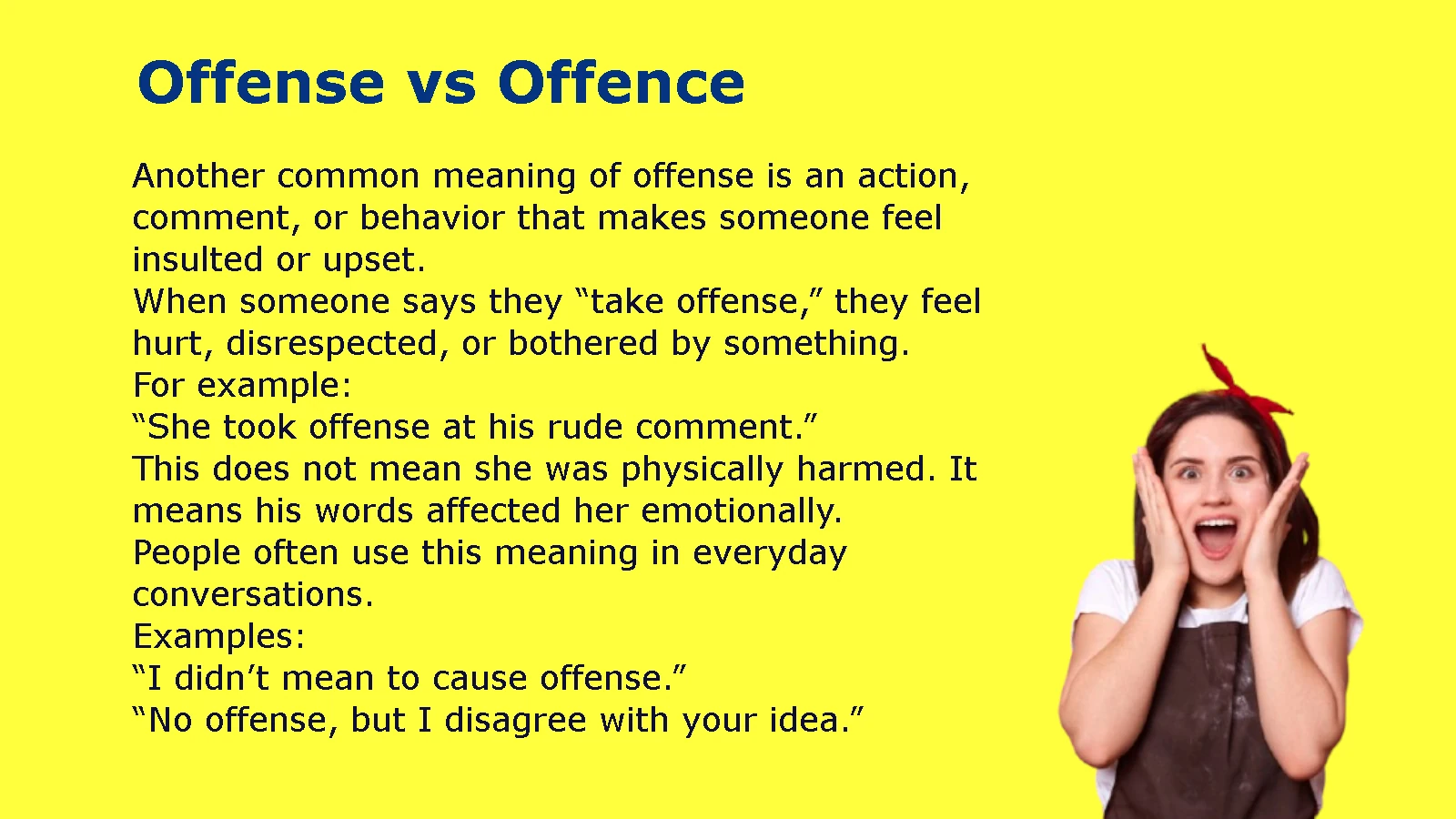
Another common meaning of offense is an action, comment, or behavior that makes someone feel insulted or upset.
When someone says they “take offense,” they feel hurt, disrespected, or bothered by something.
For example:
“She took offense at his rude comment.”
This does not mean she was physically harmed. It means his words affected her emotionally.
People often use this meaning in everyday conversations.
Examples:
- “I didn’t mean to cause offense.”
- “No offense, but I disagree with your idea.”
- “His joke caused offense among some listeners.”
Common expressions with offense:
| Phrase | Meaning | Example |
| Take offense | Feel insulted | She took offense at the criticism. |
| Cause offense | Make someone upset | The comment caused offense. |
| No offense | A polite warning before criticism | No offense, but this needs improvement. |
| Give offense | Behave in a way that insults someone | He never intended to give offense. |
Offense Meaning in Sports
In sports, offense means the players or team responsible for attacking and scoring points.
It is usually the opposite of defense.
For example:
- In football, the offense tries to move the ball and score touchdowns.
- In basketball, the offense tries to create scoring opportunities.
- In hockey, the offense focuses on attacking the opponent’s goal.
Example sentences:
“The team’s offense scored three goals in the final period.”
“Their offense struggled because they couldn’t create enough chances.”
Sports writers often use the word to describe an entire group rather than a single player.
For example:
- “The team has one of the strongest offenses in the league.”
- “Their offense needs better coordination.”
What Does Offence Mean?
Offence has exactly the same meanings as offense. The only difference is the spelling.
Writers in countries that follow British English usually choose offence, including:
- The United Kingdom
- Australia
- New Zealand
- South Africa
- Some Canadian publications
The word can describe a crime, an insult, or an attacking strategy.
Offence Meaning as a Crime
In British English, a crime or rule violation is commonly called an offence.
Examples:
“The police investigated the offence.”
“He was charged with a serious offence.”
Legal systems often use this spelling in official documents, reports, and news articles.
Common examples:
- parking offence
- criminal offence
- serious offence
- first offence
A first offence means someone has broken a rule or law for the first time.
Example:
“The judge considered his lack of previous convictions and treated it as a first offence.”
Offence Meaning as an Insult or Disrespect
Like offense, the word offence can describe emotional hurt.
Examples:
“She didn’t intend to cause offence.”
“Some people may take offence at those comments.”
The phrase take offence is especially common in British English.
American English:
“He took offense at the remark.”
British English:
“He took offence at the remark.”
The meaning stays exactly the same.
Offence Meaning in Sports
British sports writers use offence when describing attacking play.
Examples:
“The team improved its offence during the second half.”
“Their offence created several scoring opportunities.”
However, some sports communities may use different conventions depending on the country and league.
For example:
- American sports coverage usually uses offense.
- British sports coverage usually uses offence.
Why Are Offense and Offence Spelled Differently?
The difference between offense and offence comes from the history of English spelling.
Both words come from the Latin verb offendere, which means “to strike against,” “to harm,” or “to displease.”
The word entered English through Old French and eventually developed into the modern spelling we use today.
Over time, English developed regional differences.
American English writers often simplified certain spellings during the 18th and 19th centuries. British English kept many traditional spelling patterns.
This created differences like:
| American English | British English |
| offense | offence |
| defense | defence |
| pretense | pretence |
| license | licence |
The spelling change does not affect pronunciation or meaning.
Think of it like two roads leading to the same destination. The spelling looks different, but both words arrive at the same meaning.
Offense vs Offence Pronunciation
A common question is whether offense and offence are pronounced differently.
The answer is no.
Both words have the same pronunciation:
Offense / Offence:
uh-FENS
/əˈfens/
The spelling changes depending on location, but the spoken word remains the same.
Examples:
- American speaker: “That was a serious offense.”
- British speaker: “That was a serious offence.”
Both sentences sound identical when spoken.
Offense vs Offence Examples in Sentences
Seeing offense vs offence used in real sentences makes the difference much easier to understand. Since both words share the same meanings, the only thing that changes is the spelling style.
Below are examples showing how each spelling works in different situations.
| Context | American English | British English |
| Crime or violation | He committed a serious offense. | He committed a serious offence. |
| Emotional reaction | She took offense at the comment. | She took offence at the comment. |
| Sports | The team’s offense improved this season. | The team’s offence improved this season. |
| Apology phrase | I meant no offense. | I meant no offence. |
| First violation | It was his first offense. | It was his first offence. |
The meaning stays unchanged. Only the spelling follows a different regional standard.
Examples of Offense in American English
American writers use offense in newspapers, legal documents, sports articles, and everyday conversations.
Legal example:
“The suspect was charged with a criminal offense.”
Here, offense refers to an action that violates the law.
Emotional example:
“I hope you don’t take offense at my suggestion.”
Here, offense means feeling insulted or upset.
Sports example:
“The team’s offense scored 28 points in the final quarter.”
Here, offense describes the attacking side of the game.
Examples of Offence in British English
British writers use offence in the same situations.
Legal example:
“The court treated the offence as a minor violation.”
Emotional example:
“He apologized because his words caused offence.”
Sports example:
“The club needs to improve its offence before the next match.”
Common Phrases With Offense and Offence
Many English expressions use the word offense/offence. These phrases appear frequently in conversations, books, news articles, and professional writing.
Understanding them helps you recognize the word in different contexts.
“No Offense” Meaning
The phrase “no offense” is commonly used before making a statement that could sound critical or rude.
It tells the listener that you do not intend to insult them.
Examples:
“No offense, but I think this plan needs more details.”
“No offense, but that restaurant wasn’t very good.”
However, the phrase does not always prevent someone from feeling offended. Sometimes people still react negatively because the following statement may sound harsh.
For example:
“No offense, but your presentation was confusing.”
Even though the speaker tries to soften the criticism, the listener may still feel uncomfortable.
British spelling:
British English uses:
“No offence, but I disagree.”
The meaning remains identical.
“Take Offense” Meaning
The phrase take offense means to feel insulted, hurt, or upset because of something someone said or did.
Examples:
“She took offense when her idea was ignored.”
“Some people may take offense at that joke.”
The phrase often appears when someone reacts emotionally to a comment.
Similar expressions:
- feel insulted
- feel hurt
- become upset
- feel disrespected
British English uses:
“Take offence”
American English uses:
“Take offense”
“Cause Offense” Meaning
To cause offense means to make someone feel hurt or insulted.
Examples:
“The advertisement caused offense among many viewers.”
“He apologized because his comment caused offense.”
This phrase is common in formal writing because it sounds more neutral than saying someone was rude.
For example:
Instead of:
“His statement was rude.”
A formal writer might say:
“His statement caused offense.”
“First Offense” Meaning
A first offense refers to the first time someone breaks a law, rule, or agreement.
Example:
“Because it was his first offense, the judge gave him a warning.”
The phrase is common in legal and workplace situations.
Examples:
- first offense for speeding
- first offense at school
- first offense at work
British English spelling:
“Because it was his first offence, the judge gave him a warning.”
Offense vs Offence in American and British English
Understanding regional English differences helps you choose the correct spelling.
English is spoken in many countries, and each region develops its own writing conventions. The words offense and offence are a perfect example of this.
American English: Offense
In the United States, writers normally use offense.
You will see this spelling in:
- American newspapers
- US government documents
- School writing
- Business communication
- Sports coverage
Examples:
- “The defendant committed a serious offense.”
- “The offense scored late in the game.”
- “She took offense at his comment.”
American English also uses:
- defense instead of defence
- license instead of licence
- practice instead of practise (when used as a noun and verb in many contexts)
British English: Offence
In the United Kingdom, writers usually use offence.
You will find this spelling in:
- British newspapers
- UK legal documents
- Academic writing
- Professional communication
Examples:
- “The defendant committed a serious offence.”
- “The offence was investigated by police.”
- “He did not mean to cause offence.”
British English usually keeps the -ce ending in these words.
Offense vs Offence in Other English-Speaking Countries
The choice is not limited only to the United States and the United Kingdom.
Different countries follow different spelling traditions.
| Country | Common Spelling |
| United States | Offense |
| United Kingdom | Offence |
| Australia | Offence |
| New Zealand | Offence |
| South Africa | Offence |
| Canada | Often offence, but both appear |
Canada can be a little more complicated because Canadian English combines influences from both American and British English.
For example, many Canadian publications follow British-style spellings such as:
- offence
- defence
- colour
However, some organizations use American-style spellings.
The best approach is to follow the style guide of the organization or publication you are writing for.
Offense vs Offence: Which One Should You Use?
Choosing between offense and offence depends on your audience.
There is no universal winner. The correct choice depends on the type of English you need.
Use Offense If:
Choose offense when:
- You write for readers in the United States.
- You follow American English rules.
- Your workplace uses American spelling.
- You are creating content for a US-based website.
Examples:
✅ “The player committed a serious offense.”
✅ “The team’s offense needs improvement.”
Use Offence If:
Choose offence when:
- You write for readers in the United Kingdom.
- You follow British English rules.
- Your audience uses Commonwealth English.
- Your organization follows British spelling.
Examples:
✅ “The player committed a serious offence.”
✅ “The team’s offence needs improvement.”
Why Consistency Matters More Than the Choice
Many writers worry about choosing the “correct” spelling. However, the bigger issue is consistency.
A document that mixes spelling styles can look unprofessional.
For example:
❌ “The team’s offense improved, but their defence remained weak.”
This sentence mixes American and British spellings.
A consistent American version:
✅ “The team’s offense improved, but their defense remained weak.”
A consistent British version:
✅ “The team’s offence improved, but their defence remained weak.”
Professional writers usually follow one spelling system from beginning to end.
Common Mistakes When Using Offense and Offence
Although offense vs offence seems simple, several mistakes appear frequently.
Mistake: Mixing American and British Spellings
One of the most common errors is combining different spelling styles.
Incorrect:
“The player committed an offence and the defense reacted quickly.”
The sentence combines:
- British: offence
- American: defense
Better:
American English:
“The player committed an offense and the defense reacted quickly.”
British English:
“The player committed an offence and the defence reacted quickly.”
Mistake: Confusing Offense With Offensive
The words offense and offensive are related, but they have different meanings.
Offense:
A noun meaning:
- A crime
- A feeling of hurt
- An attacking strategy
Example:
“The comment caused offense.”
Offensive:
An adjective meaning:
- Rude
- Insulting
- Related to attacking
Examples:
“That joke was offensive.”
“The team played an offensive strategy.”
A simple way to remember:
- Offense = the thing
- Offensive = describing the thing
Mistake: Confusing Offense With Defense
In sports, offense and defense work as opposites.
| Word | Meaning |
| Offense | Trying to score or attack |
| Defense | Trying to stop the opponent |
Examples:
“The offense scored a touchdown.”
“The defense stopped the final play.”
The same spelling pattern applies:
American English:
- offense
- defense
British English:
- offence
- defence
Offense vs Offence vs Offensive vs Defence
The words offense, offence, offensive, and defence/defense are closely related, which can make them confusing. However, each word has its own purpose.
Understanding these differences helps you avoid common mistakes in writing.
| Word | Spelling Style | Meaning | Example |
| Offense | American English | A crime, insult, or attacking play | The player committed an offense. |
| Offence | British English | Same meaning as offense | The player committed an offence. |
| Offensive | Both English styles | Causing harm, insulting, or attacking | His comment was offensive. |
| Defense | American English | Protection or stopping an attack | The defense blocked the shot. |
| Defence | British English | Same meaning as defense | The defence blocked the shot. |
A useful trick is to remember that offense/offence is usually a noun, while offensive is usually an adjective.
For example:
- “The joke caused offense.”
- “The joke was offensive.”
The first sentence describes the reaction. The second describes the joke itself.
Offense vs Offence: Real-World Usage Examples
The difference between these spellings appears everywhere, from sports articles to legal documents.
Let’s look at how different industries use these words.
Legal Writing
Law is one of the areas where spelling consistency matters most.
American legal documents commonly use:
- criminal offense
- federal offense
- first offense
- offense committed
Examples:
“The defendant was charged with a federal offense.”
British legal writing commonly uses:
- criminal offence
- serious offence
- first offence
- offence committed
Example:
“The defendant was charged with a serious offence.”
The meaning remains identical. The spelling simply follows the legal system’s preferred English style.
Sports Writing
Sports provide one of the easiest ways to understand the difference.
In American sports:
- offense = the team trying to score
- defense = the team trying to stop scoring
Example:
“The offense scored quickly, while the defense protected the lead.”
In British sports writing:
- offence = attacking play
- defence = stopping the opponent
Example:
“The offence created several chances, but the defence held strong.”
Everyday Conversations
People use these words often when talking about feelings and opinions.
Examples:
American English:
“I didn’t mean to cause offense.”
British English:
“I didn’t mean to cause offence.”
Both sentences communicate the same idea: the speaker did not intend to upset anyone.
Case Study: How One Word Changes Across Countries
Imagine a company creates a global employee handbook.
The company has offices in:
- New York
- London
- Sydney
The handbook includes this sentence:
“Employees should avoid behavior that may cause offense.”
For the US office, this spelling works perfectly.
However, employees in the UK or Australia may expect:
“Employees should avoid behavior that may cause offence.”
Neither version is incorrect.
The best solution is to create different versions based on location or choose one international style guide and use it consistently.
This example shows why businesses, publishers, and organizations pay attention to spelling differences.
Frequently Asked Questions About Offense vs Offence
Is offense or offence correct?
Both offense and offence are correct spellings.
The difference depends on the type of English being used:
- Offense = American English
- Offence = British English and many Commonwealth varieties
Neither spelling is more correct than the other.
Is offense American or British?
Offense is mainly American English.
Writers in the United States usually use this spelling in:
- newspapers
- schools
- business documents
- legal writing
- sports coverage
Example:
“The player committed a serious offense.”
Is offence British spelling?
Yes. Offence is the standard British English spelling.
It is also common in countries that traditionally follow British spelling rules, including:
- Australia
- New Zealand
- South Africa
Example:
“The police investigated the offence.”
Do offense and offence sound the same?
Yes. Both words have the same pronunciation.
Pronunciation:
Offense / Offence
uh-FENS
/əˈfens/
The spelling changes, but the spoken word does not.
Should I use offense or offence in an essay?
Use the spelling that matches your required writing style.
For example:
- A university in the United States will usually expect offense.
- A university in the United Kingdom will usually expect offence.
If no style guide is provided, consider your audience.
The most important rule is consistency.
Is “take offense” or “take offence” correct?
Both are correct.
The spelling depends on your version of English.
American English:
“She took offense at the comment.”
British English:
“She took offence at the comment.”
The meaning is exactly the same.
Quick Memory Trick for Offense vs Offence
If you often forget which spelling to use, remember this simple rule:
American English usually uses “-se.”
British English usually uses “-ce.”
Examples:
American:
- offense
- defense
- pretense
British:
- offence
- defence
- pretence
Think of the letter S as standing for States.
United States → offense
Think of the letter C as connecting with Commonwealth countries.
Commonwealth → offence
This trick is not perfect for every English word, but it works well for this spelling pattern.
Related American vs British Spelling Differences
The offense vs offence difference is part of a larger pattern in English.
Here are some other common examples:
| American English | British English | Meaning |
| color | colour | A visual quality |
| center | centre | Middle point |
| meter | metre | Unit or measuring device |
| defense | defence | Protection |
| offense | offence | Crime or attack |
| organize | organise | Arrange or plan |
Learning these patterns can help you write more naturally for different audiences.
Final Thoughts on Offense vs Offence
The difference between offense vs offence is simple once you understand the pattern.
Both words:
- Have the same meaning
- Sound the same
- Are grammatically correct
- Describe crimes, insults, or attacking play
The only difference is regional spelling.
Use offense when writing in American English. Use offence when writing in British English or following British spelling rules.
The key is not choosing the “better” word. The key is choosing the right style for your readers and staying consistent.
A small spelling choice can make your writing feel more natural, professional, and connected to your audience.
Whether you write “no offense” or “no offence,” the message remains the same: clear communication matters more than the spelling difference.