Have you ever wondered whether leaking or leeking is the correct spelling? These two forms may look similar, but Leaking vs Leeking is not a case of American versus British English. One is a standard English word, while the other is generally considered a misspelling. Knowing the difference can help you avoid confusion when describing something that is allowing liquid, gas, or information to escape.
Leaking is the correct spelling and is the present participle of the verb leak. It means allowing something such as water, gas, air, or information to escape or become known. Leeking is not the standard spelling of this word and should generally be avoided in formal or standard English writing.
Examples:
- The kitchen faucet is leaking water.
- The reporter was accused of leaking confidential information.
The confusion is understandable. People may search for leaking vs leeking, leaking or leeking, which spelling is correct, or leaking meaning in English because the two spellings sound similar and differ by only one letter. However, leaking is the correct form when you mean that something is escaping from a container, system, or source.
In this guide, you’ll learn the complete difference between Leaking vs Leeking, including their meaning, pronunciation, correct spelling, usage, and examples. You’ll also discover why leaking is the correct word and how to use it naturally in different sentences.
Leaking vs Leeking: Which Spelling Is Correct?
Leaking is the correct spelling when you’re using the -ing form of leak.
The verb leak has several forms:
- Base form: leak
- Third-person singular: leaks
- Past tense: leaked
- Past participle: leaked
- Present participle / -ing form: leaking
Oxford lists leaking as the -ing form of leak, while Cambridge also identifies leaking as the present participle of the verb.
For example:
- The pipe is leaking.
- Water is leaking through the ceiling.
- The tank started leaking overnight.
- Someone is leaking confidential information.
In each sentence, leaking follows the spelling of the base verb leak.
Why Is “Leeking” Incorrect?
The spelling leeking doesn’t follow the standard spelling of the verb leak. English has many words that contain ee, so the mistake can feel natural when you’re writing by sound.
For example:
- see
- feel
- keep
- sleep
- need
Those words use ee, but leak uses ea.
The pronunciation doesn’t provide a reliable way to choose the spelling because ea and ee can represent similar vowel sounds in English. That’s why remembering the base word is more useful than trying to spell leaking purely from pronunciation.
Think of it as a word family:
leak → leaking → leaked → leakage → leaky
The spelling remains connected to leak.
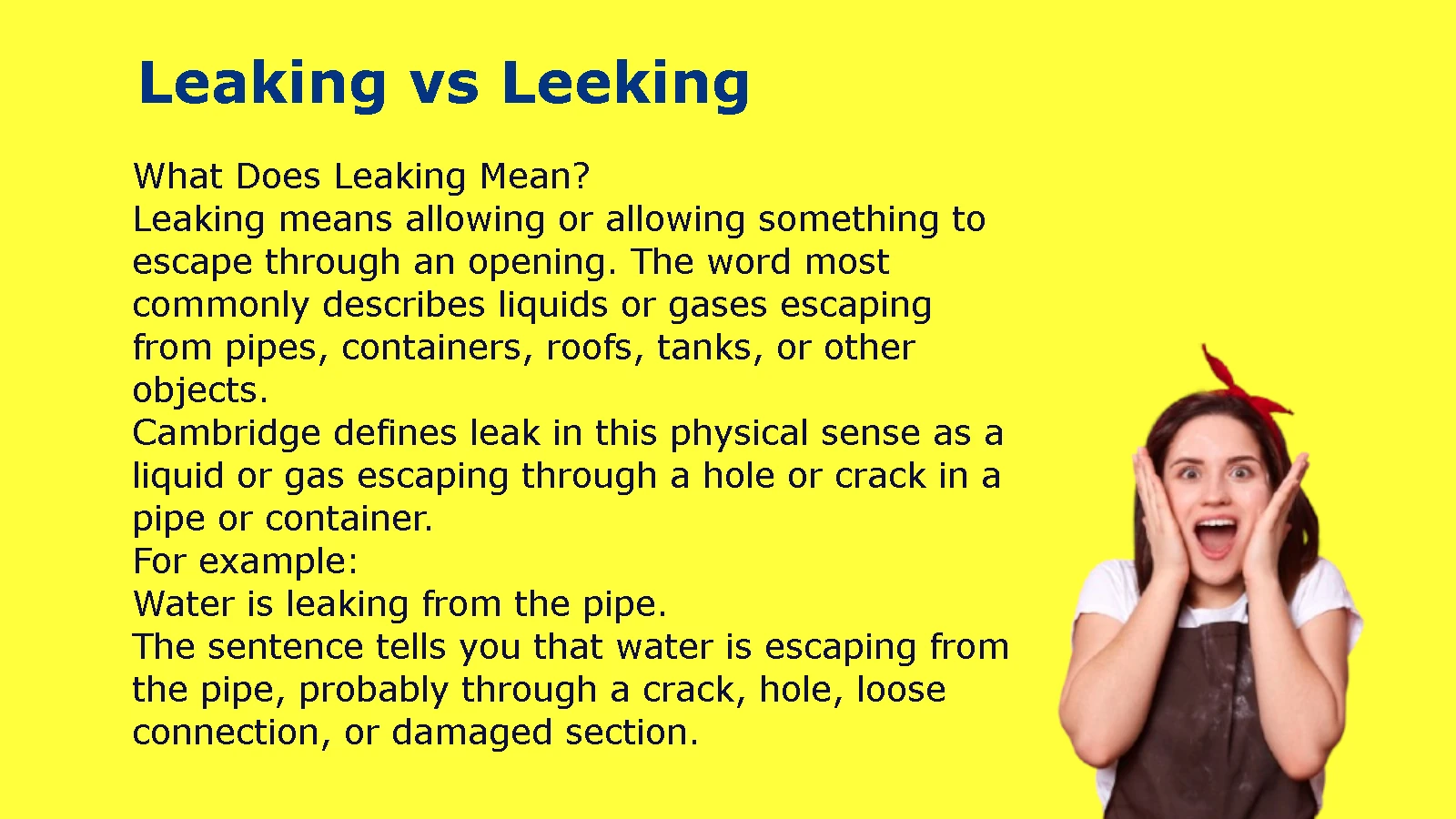
What Does Leaking Mean?
Leaking means allowing or allowing something to escape through an opening. The word most commonly describes liquids or gases escaping from pipes, containers, roofs, tanks, or other objects.
Cambridge defines leak in this physical sense as a liquid or gas escaping through a hole or crack in a pipe or container.
For example:
Water is leaking from the pipe.
The sentence tells you that water is escaping from the pipe, probably through a crack, hole, loose connection, or damaged section.
Leaking Water
Water provides one of the most common uses of leaking.
You might say:
- The faucet is leaking.
- Water is leaking under the sink.
- The roof is leaking.
- The pipe has started leaking.
- Rainwater is leaking through the window.
- The bottle is leaking inside my backpack.
The word describes an ongoing situation. If the water is escaping right now, leaking works naturally with forms of be:
The pipe is leaking.
The roof is leaking.
Water is leaking onto the floor.
This is the present progressive construction:
is/are + leaking
Leaking Gas or Oil
The same word applies to gases and other substances.
For example:
- Gas is leaking from the tank.
- Oil is leaking from the engine.
- The container is leaking chemicals.
- Air is leaking from the tire.
- The pipe is leaking fuel.
This usage isn’t limited to household plumbing. Engineers, mechanics, construction workers, safety professionals, and scientists can all use leaking to describe an unwanted escape from a system or container.
Oxford gives examples involving leaking pipes, roofs, tanks, water, gas, and other substances.
Leaking Information: A Different Meaning
Leaking doesn’t always involve water, gas, or another physical substance.
The verb leak also has an important figurative meaning: to reveal secret or confidential information to people who weren’t supposed to receive it. Both Cambridge and Oxford recognize this meaning.
For example:
Someone is leaking confidential information to the press.
Here, nothing is physically escaping from a pipe. Instead, information is spreading beyond its intended audience.
You might see this usage in journalism, politics, business, entertainment, technology, and legal reporting.
Examples include:
- Someone is leaking details about the investigation.
- The company suspects that an employee is leaking information.
- News about the new product started leaking online.
- Confidential documents are leaking to the media.
- Details of the agreement were leaking before the official announcement.
This sense of leaking often suggests that information is becoming public without authorization.
Leaking vs Leaked Information
The tense changes the meaning slightly.
Leaking:
Someone is leaking the information.
This describes an action that is happening or continuing.
Leaked:
Someone leaked the information yesterday.
This describes an action that happened in the past.
Oxford specifically lists leaked as the past form and leaking as the -ing form of leak.
What Does Leeking Mean?
When someone writes leeking while trying to use the verb leak, they generally mean leaking.
In standard English, leeking isn’t the normal -ing form of leak. Standard dictionaries identify leaking as the correct form.
So these sentences should be written as follows:
❌ The roof is leeking.
✅ The roof is leaking.
And:
❌ Oil is leeking from the engine.
✅ Oil is leaking from the engine.
The same correction applies when you’re talking about information:
❌ Someone is leeking confidential files.
✅ Someone is leaking confidential files.
Is Leeking Ever a Word?
It’s important not to make an overly broad claim that a spelling can never appear anywhere. English contains proper names, surnames, place names, brand names, specialized terms, and other unusual forms.
However, leeking isn’t the standard spelling of the -ing form of the ordinary English verb leak.
Therefore, if your intended sentence is:
“The pipe is ___.”
the correct choice is:
The pipe is leaking.
Why Is It Spelled Leaking Instead of Leeking?
The easiest way to understand the spelling is to start with the base word.
Leak → Leaking
The word leak already contains the vowel combination ea.
When you form its -ing version, you add -ing:
leak + ing = leaking
No change turns ea into ee.
That’s why:
- leak → leaking
- speak → speaking
- break → breaking
- sneak → sneaking
The spelling pattern becomes easier to remember when you connect the -ing form to its base word.
Don’t Spell From Sound Alone
One reason leeking looks tempting is pronunciation.
Leak and leaking contain the long e sound. English represents that sound in several ways, including ee, ea, and other spelling patterns.
For example:
- see
- green
- team
- dream
- leak
They don’t all use the same letters even though their vowel sounds are closely related.
That’s why spelling by sound can lead you astray. When you’re unsure, identify the base word first:
leaking → leak
Once you recognize leak, the spelling becomes much easier.
Leaking as a Verb Form
Leaking is grammatically useful because the -ing form can appear in several structures.
Cambridge identifies leaking specifically as the present participle of leak.
Leaking in the Present Progressive
The most common structure is:
am/is/are + leaking
Examples:
- I think the pipe is leaking.
- The roof is leaking again.
- The pipes are leaking water.
- The tank is leaking fuel.
- The container is leaking chemicals.
This construction describes an action or condition that is happening around the time you’re talking about it.
Leaking as a Participle
The -ing form can also modify a noun.
For example:
We replaced the leaking pipe.
Here, leaking describes the pipe.
More examples:
- a leaking faucet
- a leaking roof
- a leaking container
- a leaking tire
- a leaking tank
- a leaking gas line
The word doesn’t need to appear after is, are, or another form of be.
Leaking as a Gerund
An -ing form can also function as a noun-like element in a sentence.
For example:
Leaking can cause serious water damage.
Here, leaking refers to the activity or condition itself.
Another example:
The leaking of confidential information caused a major problem.
However, in everyday English, leakage may sound more natural when you’re naming the problem or phenomenon.
Leaking vs Leakage
These words are related, but they don’t always perform the same grammatical job.
Leaking usually focuses on the action or ongoing condition.
Leakage is a noun referring to the act, condition, amount, or occurrence of something escaping.
Cambridge defines leakage as the act of leaking or the leak itself and also recognizes its use for the disclosure of information.
Compare these sentences:
Water is leaking from the pipe.
The leakage was traced to a damaged pipe.
The first sentence emphasizes what is happening.
The second emphasizes the problem or occurrence.
Oxford similarly defines leakage as an amount of liquid or gas escaping through a hole or an occasion when there is a leak.
| Word | Typical role | Example |
| Leak | Verb or noun | The pipe may leak. |
| Leaking | -ing form / participle / gerund | The pipe is leaking. |
| Leaked | Past tense / past participle | The pipe leaked yesterday. |
| Leakage | Noun | The leakage damaged the floor. |
| Leaky | Adjective | We need to replace the leaky pipe. |
Leak vs Leaking vs Leaked
These three forms are easy to confuse because they belong to the same word family.
Leak
Use leak as the base form.
Examples:
- The pipe may leak.
- Check the container for damage that could make it leak.
- Oil can leak from a damaged engine.
- Someone might leak the information.
Leaking
Use leaking for an ongoing action or condition, or when the -ing form modifies a noun.
Examples:
- The pipe is leaking.
- Water is leaking into the basement.
- We found a leaking container.
- Someone is leaking confidential documents.
Leaked
Use leaked for the past tense or past participle.
Examples:
- The pipe leaked yesterday.
- The tank leaked several gallons of fuel.
- Someone leaked the report.
- The leaked document appeared online.
Oxford lists leaked as both the past simple and past participle and leaking as the -ing form.
Leaking vs Leeking Examples
The clearest way to remember the difference is to see the correct spelling in real sentences.
Examples About Water
- The kitchen faucet is leaking.
- Water is leaking through the ceiling.
- The pipe started leaking after the storm.
- We noticed that the bathroom sink was leaking.
- The old roof keeps leaking whenever it rains.
- The bottle is leaking water into my bag.
About Gas, Oil, and Other Substances
- Gas is leaking from the damaged line.
- Oil is leaking from the engine.
- The tank is leaking fuel.
- The container started leaking chemicals.
- Air is leaking from the tire.
Information
- Someone is leaking confidential information.
- Details about the project are leaking online.
- The company is investigating who is leaking the documents.
- News of the merger began leaking before the official announcement.
- Employees were warned against leaking sensitive information.
Incorrect vs Correct Examples
| Incorrect | Correct |
| The pipe is leeking. | The pipe is leaking. |
| Water is leeking onto the floor. | Water is leaking onto the floor. |
| The roof has been leeking for days. | The roof has been leaking for days. |
| Someone is leeking the report. | Someone is leaking the report. |
| The tank started leeking oil. | The tank started leaking oil. |
Common Mistakes With Leaking
The most common mistake is straightforward: replacing the ea in leak with ee.
However, a few related mistakes can also cause confusion.
Mistake: Writing Leeking Instead of Leaking
This is the main spelling error.
❌ The roof is leeking.
✅ The roof is leaking.
The simplest correction strategy is to work backward from the base verb:
leaking → leak
Once you see the base word, the correct spelling becomes obvious.
Mistake: Confusing Leaking With Leakage
These words aren’t interchangeable in every sentence.
❌ The leakage pipe needs to be repaired.
✅ The leaking pipe needs to be repaired.
Why?
Leaking describes the pipe.
Leakage names the escape or the problem.
Compare:
The leaking pipe damaged the floor.
The leakage damaged the floor.
Both sentences can work, but they structure the information differently.
Mistake: Using Leaked for an Ongoing Situation
If something is happening now, leaking usually fits better.
The pipe is leaking.
If the event happened in the past, use leaked.
The pipe leaked last night.
This distinction helps you choose the right word form even when spelling isn’t the issue.
A Simple Case Study: Choosing the Right Word
Imagine someone notices water collecting underneath a kitchen sink.
They could describe the situation in several ways:
The pipe is leaking.
This emphasizes the current problem.
Later, they might say:
The pipe leaked overnight.
Now the sentence focuses on a past event.
After a plumber fixes the problem, they might write:
The plumber repaired the leakage.
Here, leakage functions as a noun describing the problem.
If the pipe still has a problem, they could describe it as:
It’s a leaky pipe.
The underlying concept stays the same, but English changes the word form depending on the grammatical job.
That distinction is more useful than simply memorizing one spelling.
How to Remember the Correct Spelling of Leaking
A short memory trick can save you from the leeking mistake.
Remember the Base Word
Think:
LEAK → LEAKING
The word leaking keeps the ea from leak.
You don’t need to memorize leaking as an unrelated word. Treat it as part of the same family.
Use the “A Leak Is Leaking” Trick
One easy mnemonic is:
A leak is leaking.
Both words share leak.
That visual connection helps reinforce the correct spelling.
Check the Word Family
When you’re uncertain, compare related forms:
- leak
- leaks
- leaked
- leaking
- leakage
- leaky
Seeing the same lea sequence across the word family makes leeking look much less plausible.
Leaking vs Leeking: Quick Comparison
| Feature | Leaking | Leeking |
| Standard spelling | ✅ Yes | ❌ No |
| Related base word | leak | — |
| -ing form of leak | ✅ Yes | ❌ No |
| Can describe escaping liquid | ✅ Yes | ❌ Not as the standard form |
| Can describe information becoming known | ✅ Yes | ❌ Not as the standard form |
| Recommended in formal writing | ✅ Yes | ❌ No |
| Example | The pipe is leaking. | The pipe is leeking. |
Why the Confusion Happens
The leaking vs leeking confusion is understandable because English spelling doesn’t always match pronunciation neatly.
The vowel sound in leak is similar to the vowel sound found in words such as seek and week. Yet English doesn’t use one universal spelling for that sound.
Consider:
- leak
- seek
- week
- speak
- team
- green
Some use ea while others use ee.
As a result, someone who hears leaking may reasonably wonder whether it should be spelled with ea or ee. The answer comes from the base word rather than the sound:
leak + ing = leaking
This is a useful spelling strategy beyond this one word. When an -ing form seems difficult, identify the base verb first.
Is Leeking a Word?
Leeking is not the standard spelling of the -ing form of leak.
If you’re writing about a pipe, roof, tank, faucet, gas line, or confidential information, use leaking.
For example:
The roof is leaking.
Someone is leaking the information.
Major learner dictionaries identify leaking as the correct present participle or -ing form of leak.
That said, unusual spellings can appear as names or other proper forms in real-world text. Such cases don’t change the standard English spelling of the verb.
Frequently Asked Questions About Leaking vs Leeking
Is leaking or leeking correct?
Leaking is correct when you mean the -ing form of the verb leak.
The pipe is leaking.
Leeking is not the standard spelling of this verb form.
Is leeking a word?
Leeking is not the standard English spelling of the -ing form of leak. In ordinary writing, use leaking instead.
What is the -ing form of leak?
The -ing form of leak is leaking.
The faucet is leaking.
Both Cambridge and Oxford list leaking as the correct -ing form.
What is the past tense of leak?
The past tense of leak is leaked.
The pipe leaked yesterday.
Oxford lists leaked as both the past simple and past participle of leak.
What does leaking mean?
Leaking means allowing a liquid or gas to escape through an opening. It can also mean allowing secret information to become known.
For example:
Water is leaking from the pipe.
Someone is leaking confidential information.
Both meanings appear in major English dictionaries.
Is leaking a verb or an adjective?
Leaking can serve different grammatical roles depending on the sentence.
In:
The pipe is leaking.
it forms the present progressive verb phrase.
In:
The leaking pipe needs repair.
it functions as a participial modifier describing pipe.
What is the difference between leaking and leakage?
Leaking usually describes an action or ongoing condition.
Leakage is a noun referring to the act, occurrence, amount, or condition of something escaping.
For example:
Water is leaking from the tank.
The leakage was difficult to locate.
Cambridge and Oxford both recognize leakage as a noun related to escaping liquid or gas.
How do you use leaking in a sentence?
You can use leaking to describe an ongoing physical leak:
The roof is leaking after the heavy rain.
You can also use it for information:
Someone is leaking confidential documents to the media.
How do you spell leaking?
The correct spelling is:
L-E-A-K-I-N-G
A useful way to remember it is:
leak + ing = leaking
Don’t change ea to ee.
Final Verdict: Leaking or Leeking?
When you’re deciding between leaking vs leeking, choose leaking.
Leaking is the standard -ing form of leak. It can describe water, gas, oil, air, chemicals, or other substances escaping from a container or system. It can also describe confidential information becoming known. Major English dictionaries confirm leaking as the correct form.
Leeking isn’t the standard spelling when you mean the -ing form of leak.
The easiest rule is simple:
leak → leaking
So if you’re writing about a damaged pipe, a wet ceiling, a leaking tire, or confidential information reaching the public, stick with leaking.
Correct: The pipe is leaking.
Incorrect: The pipe is leeking.