Knight vs night is a comparison between two English homophones that sound exactly alike but have different spellings and meanings. A knight is a medieval warrior or a person who receives an honorary title, while night refers to the period of darkness between sunset and sunrise. Both words are pronounced /naɪt/, but their meanings depend on how you use them in a sentence.
The difference becomes easier to understand when you look at their spelling, pronunciation, word origins, and everyday usage. The word knight has a silent K and usually relates to medieval history, royalty, or chess. In contrast, night describes darkness, nighttime activities, sleep, and the hours between evening and morning. Understanding these homophones, silent letters, and English spelling differences will help you choose the correct word every time.
| Question | Answer |
| What is the difference between knight and night? | Knight means a warrior or an honorary titleholder, while night means the period of darkness between sunset and sunrise. |
| Are knight and night homophones? | Yes. Both words have the same pronunciation but different spellings and meanings. |
| How do you pronounce knight and night? | Both are pronounced /naɪt/. The K and GH in knight are silent. |
| What is the homophone of night? | Knight is the primary homophone of night. |
| Is it night or nite? | Night is the standard spelling. Nite is an informal or stylized alternative. |
What Is the Difference Between Knight and Night?
The main difference between knight and night is their meaning. A knight is a medieval warrior or someone who receives an honorary title from a monarch. Night is the time of darkness between sunset and sunrise. Although both words sound identical, their spelling and grammatical contexts distinguish them.
Here is a closer look at each word.
Knight Meaning and Usage
A knight is traditionally a mounted warrior who served a king, queen, or noble during the medieval period. Knights often trained in horseback riding, swordsmanship, and military combat. They also followed a code of conduct associated with loyalty, courage, and service.
Historically, becoming a knight involved more than wearing armor and carrying a sword. In many European societies, a young man trained for years before receiving the title. His responsibilities could include protecting a lord’s land, serving in battles, and defending important settlements.
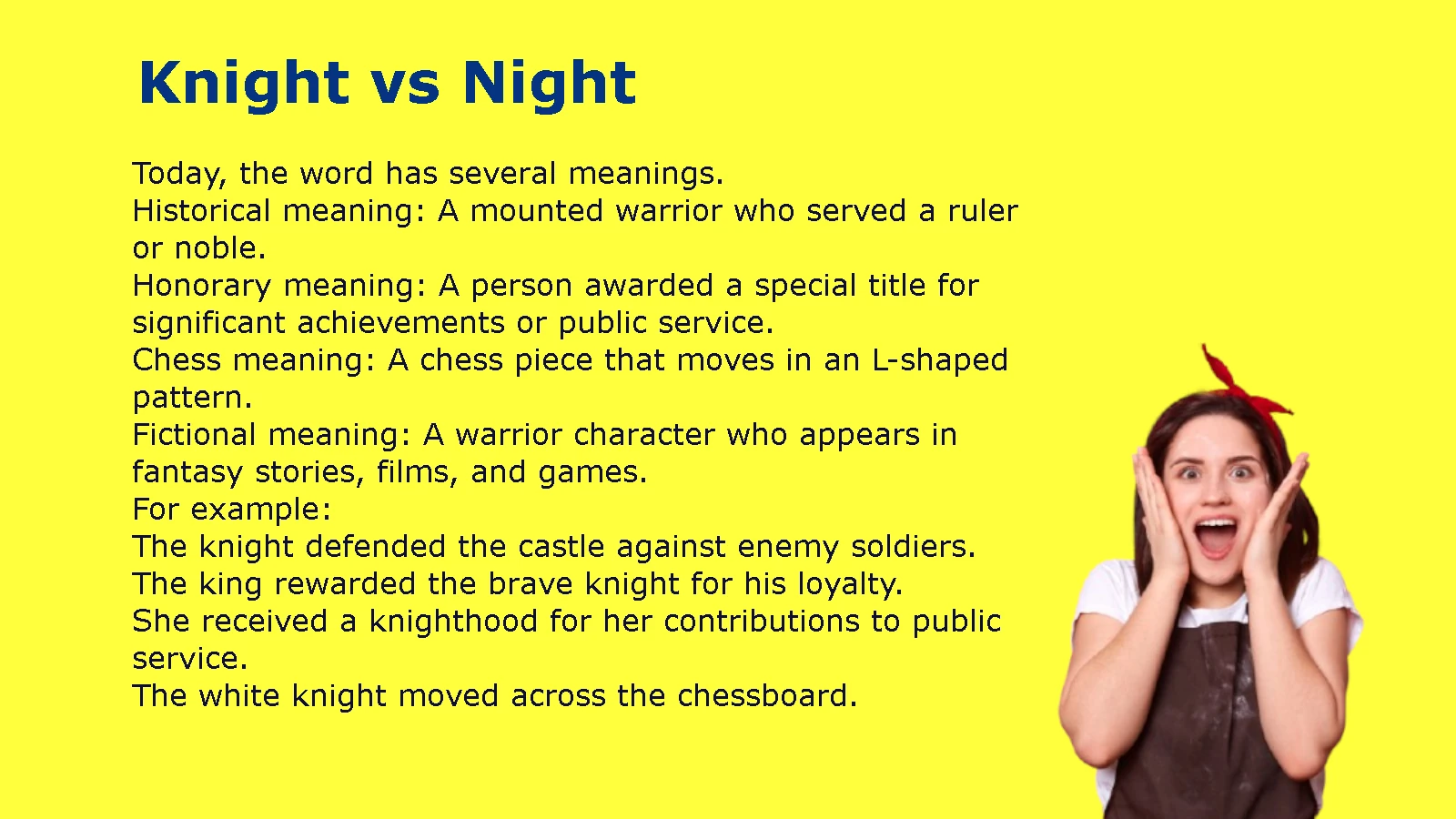
Today, the word has several meanings.
- Historical meaning: A mounted warrior who served a ruler or noble.
- Honorary meaning: A person awarded a special title for significant achievements or public service.
- Chess meaning: A chess piece that moves in an L-shaped pattern.
- Fictional meaning: A warrior character who appears in fantasy stories, films, and games.
For example:
- The knight defended the castle against enemy soldiers.
- The king rewarded the brave knight for his loyalty.
- She received a knighthood for her contributions to public service.
- The white knight moved across the chessboard.
The word can also appear in expressions such as knight in shining armor, which describes someone who arrives to help another person during a difficult situation.
Night Meaning and Usage
Night refers to the period when a location experiences darkness between sunset and sunrise. It is the opposite of daytime and usually occurs when a particular part of Earth faces away from the Sun.
People use the word in conversations about sleep, work schedules, travel, entertainment, and daily routines.
For example:
- We watched the stars throughout the night.
- She prefers studying at night because the house stays quiet.
- They arrived at the hotel late last night.
- My father works the night shift at the hospital.
- The children went to bed early on Sunday night.
Night also appears in many common English expressions.
| Expression | Meaning | Example |
| Good night | A farewell before sleeping or leaving late in the evening | Good night! See you tomorrow. |
| Last night | The previous evening or night | We watched a movie last night. |
| Tonight | The current evening or night | We have dinner plans tonight. |
| At night | During nighttime | The streets become quieter at night. |
| Night shift | A work period during nighttime hours | My brother works the night shift. |
| All night | Throughout the entire night | The baby cried all night. |
| Night owl | Someone who stays awake late | My sister is a night owl. |
Unlike knight, which generally refers to a person or chess piece, night describes a period of time.
Knight vs Night: Quick Comparison Table
The following table highlights the main differences between these homophones.
| Feature | Knight | Night |
| Meaning | A medieval warrior or honorary titleholder | Darkness between sunset and sunrise |
| Pronunciation | /naɪt/ | /naɪt/ |
| Part of speech | Noun | Noun |
| First letter | K | N |
| Silent letters | K and GH | None |
| Historical association | Medieval warriors and royalty | Darkness and nighttime |
| Modern usage | Titles, chess, history, and fiction | Sleep, evening, work, and daily activities |
| Example | The knight carried a sword. | We walked home at night. |
Remember: Both words have the same pronunciation, but you cannot exchange them freely. Their meanings determine which spelling belongs in a sentence.
Are Knight and Night Homophones?
Yes, knight and night are homophones because they share the same pronunciation but have different spellings and meanings. Both words sound like /naɪt/. The silent K and GH in knight do not affect its modern pronunciation, which makes the two words sound identical in standard English.
Homophones are words that sound alike but differ in spelling, meaning, or both. English contains many examples, including their and there, write and right, and flower and flour.
Knight and night are another common example.
Why Do Knight and Night Sound the Same?
The identical pronunciation comes from changes in English over several centuries.
The word knight once had a pronunciation that included sounds no longer used in modern English. Early forms of the word contained a pronounced initial K and a guttural sound represented by GH.
Over time, English pronunciation changed. Speakers gradually stopped pronouncing the initial K, and the older guttural sound disappeared. However, the traditional spelling remained.
The word night also developed through historical pronunciation changes. Its spelling and sound evolved into the modern form used today.
As a result, both words eventually developed the same standard pronunciation.
Consider these spelling and sound differences:
- Knight: The K is silent, and GH does not produce a separate sound.
- Night: The N is pronounced normally, and the word contains no silent initial letter.
- Both: The vowel sound and final T sound are identical.
This explains why someone hearing either word cannot identify its spelling from pronunciation alone. The surrounding sentence provides the necessary information.
What Is the Homophone of Night With Meaning?
The primary homophone of night is knight. It refers to a medieval warrior or a person awarded an honorary title. Although the two words sound identical, their meanings differ completely. Night describes a period of darkness, while knight identifies a person or a chess piece.
For example:
- The knight entered the castle at night.
- We heard a story about a brave knight before bedtime.
- The knight traveled through the forest after nightfall.
These examples show how one sentence can contain both homophones without creating confusion.
Other English homophone pairs include:
| Word 1 | Word 2 | Meaning |
| Knight | Night | Warrior / darkness |
| Right | Write | Correct or opposite of left / produce written text |
| Sea | See | Large body of salt water / perceive with your eyes |
| Hear | Here | Perceive sound / in this place |
| Son | Sun | Male child / the star at the center of our solar system |
| One | Won | Number 1 / past tense of win |
| Pair | Pear | Two matching items / a fruit |
Homophones can create spelling mistakes because listeners cannot always identify the intended word without context.
Knight and Night Pronunciation
Knight and night share the same standard English pronunciation: /naɪt/. Both contain one syllable, the same long I diphthong, and the same final T sound. The main difference appears in their spelling rather than their spoken form. Knight contains silent letters, while night begins with a pronounced N.
Understanding their pronunciation helps explain why these words belong to the same homophone pair.
Knight Pronunciation and Meaning
The word knight is pronounced /naɪt/.
It contains one syllable, and its pronunciation follows three main sound elements:
- /n/ represents the opening consonant sound.
- /aɪ/ represents the vowel sound heard in words such as time and light.
- /t/ represents the final consonant sound.
The written K does not produce a sound. The letters GH are also silent.
Although the spelling looks more complicated than the pronunciation, the spoken word is simple.
Examples:
- The knight protected the royal family.
- A knight rode across the battlefield.
- The chess player moved the knight toward the center.
In each sentence, the word has the same pronunciation.
Night Pronunciation
The word night is also pronounced /naɪt/.
Its pronunciation contains the same three sound elements:
- N: The opening consonant.
- I: The vowel sound /aɪ/.
- T: The final consonant.
Unlike knight, the word does not contain a silent initial letter. Every written consonant contributes to its spelling, although the letter sequence GH in the word’s historical spelling is absent.
Examples:
- We enjoyed a peaceful night.
- The children slept throughout the night.
- Stars appeared in the sky after nightfall.
The pronunciation remains the same whether someone uses the word in a conversation, a book, or a formal presentation.
Is the K Silent in Knight?
Yes, the K in knight is silent. You pronounce the word as /naɪt/, not by producing a separate K sound at the beginning. This spelling comes from an earlier stage of English when the initial K was pronounced. Modern English retained the traditional spelling even after the sound disappeared.
Several other English words also contain a silent K before N.
| Word | Pronunciation | Example |
| Knight | /naɪt/ | The knight carried a shield. |
| Knee | /niː/ | He injured his knee. |
| Knife | /naɪf/ | She used a sharp knife. |
| Know | /noʊ/ | I know the answer. |
| Knock | /nɑːk/ | Please knock on the door. |
| Knot | /nɑːt/ | Tie a knot in the rope. |
A useful spelling rule is that the K is generally silent when it appears at the beginning of a word before N.
This pattern helps explain the pronunciation of knight and makes it easier to recognize other silent-K words.
Knight and Night Homophones Sentences
Knight and night homophones appear frequently in English sentences because they share a pronunciation but serve different meanings. Use knight when discussing a warrior, an honorary title, or a chess piece. Choose night when describing darkness, bedtime, or nighttime activities. Context determines which spelling is correct.
The easiest way to learn the difference is to compare both words in complete sentences.
Knight and Night Sentences Together
Here are original sentences that use both homophones naturally.
- The knight rode his horse through the forest at night.
- A brave knight guarded the castle throughout the night.
- The king asked the knight to return before nightfall.
- The young knight trained during the day and rested at night.
- The knight carried a sword while traveling through the dark night.
- A mysterious knight appeared outside the village late at night.
- The story described a knight who protected travelers during the night.
- The knight reached the palace just before night arrived.
Each example uses knight for a person and night for a period of darkness.
Notice how the surrounding words help identify the correct spelling. Words such as sword, castle, king, and warrior usually provide clues that the sentence needs knight. Expressions such as dark, sleep, evening, and sunset often point toward night.
Sentences Using Knight
The following examples demonstrate different meanings and contexts of the word knight.
Historical context
- The knight served the king during the medieval period.
- Every young knight had to develop military skills before joining the royal army.
- The knight defended the village from invading soldiers.
Honorary title
- The musician received the title of knight for his contribution to the arts.
- The king decided to knight the soldier after years of distinguished service.
Chess
- The white knight moved two squares forward and one square sideways.
- She used her knight to capture an opponent’s bishop.
Fiction and storytelling
- The brave knight rescued the princess from the dragon.
- A mysterious knight arrived at the castle carrying a silver shield.
These examples show that the word does not always refer to a medieval soldier. Its modern meaning can also involve honorary recognition, chess, and fictional characters.
Sentences Using Night
Here are examples showing how night appears in everyday communication.
Sleep and bedtime
- My little brother usually goes to bed before nine at night.
- I could not sleep well last night.
- The baby woke up several times during the night.
Travel and outdoor activities
- We drove through the mountains at night.
- The city looks beautiful under the lights at night.
- They planned a night walk along the beach.
Work and daily routines
- My uncle works the night shift at a local hospital.
- She prefers reading at night because there are fewer distractions.
- The restaurant stays open late at night.
Social activities
- We organized a movie night for our friends.
- Friday night is usually our family dinner night.
- They enjoyed a wonderful night at the concert.
These examples demonstrate that night has many uses beyond describing darkness. It can also appear in expressions about schedules, entertainment, and social events.
Common Knight vs Night Spelling Mistakes
People sometimes confuse these words because they sound identical. However, replacing one with the other can completely change a sentence’s meaning.
Consider these incorrect examples:
| Incorrect sentence | Correct sentence | Explanation |
| The night protected the castle. | The knight protected the castle. | A person protects the castle, not a period of darkness. |
| I slept well last knight. | I slept well last night. | The sentence refers to the previous evening. |
| The king rewarded the night. | The king rewarded the knight. | The king rewards a person. |
| We watched the stars during the knight. | We watched the stars during the night. | Stars appear in the nighttime sky. |
| The night carried a sword. | The knight carried a sword. | A warrior carries a sword. |
A simple memory trick:
- Knight has a K, just like king. Both can relate to royalty and medieval history.
- Night begins with N, just like nighttime and nightfall.
This association gives you a quick way to remember the correct spelling.
Knight Night Meaning: What Does It Mean?
The phrase knight night does not have one fixed meaning in standard English. Its interpretation depends on context. It may refer to a knight-themed event, a playful combination of the homophones, or a creative title. However, night-night is a separate informal expression that people use to say good night.
The difference between these expressions matters because their spellings communicate different ideas.
What Does Night-Night Mean?
Night-night is an informal and affectionate way to say good night. People often use it when speaking to young children, family members, partners, or close friends before bedtime.
The expression sounds friendly and gentle. It is common in casual conversations, especially when someone wants to make a bedtime farewell feel warm or playful.
Examples:
- Night-night, sweetheart. Sleep well.
- The mother kissed her daughter and said night-night.
- It is getting late, so night-night, everyone!
- The children waved goodbye and wished their grandparents night-night.
Although night-night appears in informal English, it does not replace the standard expression good night in every situation.
For example:
- Formal or neutral: Good night. I will see you tomorrow.
- Informal and affectionate: Night-night! See you in the morning.
Both expressions communicate a bedtime farewell, but they differ in tone.
What Does Knight Night Mean in a Sentence?
The phrase knight night can work as a creative combination when someone deliberately plays with the two homophones.
For example, a school might organize a medieval-themed evening and call it a Knight Night. The title combines knight, referring to the medieval theme, with night, describing an evening event.
Other possible examples include:
- The school organized a Knight Night with medieval costumes and games.
- Our community hosted a Knight Night to celebrate its local history.
- The children enjoyed a Knight Night featuring castles, swords, and storytelling.
These are creative uses rather than fixed dictionary expressions.
The distinction is important:
| Expression | Meaning | Typical context |
| Knight night | A creative phrase or themed event title | Medieval events and wordplay |
| Night-night | An affectionate way to say good night | Bedtime conversations |
| Good night | A standard farewell | Everyday and formal situations |
If someone writes knight night when they mean a bedtime farewell, the spelling is generally incorrect. The appropriate expression is good night or night-night.
Night vs Nite: Which Spelling Is Correct?
Night is the standard English spelling for the period of darkness between sunset and sunrise. Nite is an informal or stylized alternative that sometimes appears in advertising, business names, event titles, and casual messages. Use night in academic assignments, professional communication, and standard writing.
Although both spellings can communicate the same basic idea, they do not have the same level of acceptance in formal English.
Is Nite a Real Word?
Yes, nite appears in informal English and is widely recognizable as a stylized spelling of night. It is often used to create short, catchy names or give a business, event, or advertisement a casual tone.
For example:
- Movie Nite
- Ladies’ Nite
- Game Nite
- Friday Nite
- Date Nite
These spellings are often intentional. Businesses and event organizers may choose nite because it looks shorter or more distinctive in a promotional title.
However, you should generally avoid using it in standard writing.
Consider these situations:
Appropriate uses of nite:
- A restaurant advertises a special Movie Nite.
- A community center promotes a Friday Nite event.
- A brand uses Nite as part of its official name.
- Friends write an informal message using the stylized spelling.
Situations where night is preferred:
- School assignments
- Business emails
- Academic writing
- News articles
- Professional reports
- Standard website content
The key distinction is that nite is a nonstandard spelling, while night is the normal spelling used in modern English.
Night vs Nite: Examples
| Standard spelling | Informal or stylized spelling |
| Good night | Good nite |
| Movie night | Movie nite |
| Friday night | Friday nite |
| Date night | Date nite |
| Game night | Game nite |
| Ladies’ night | Ladies’ nite |
For example:
- Standard: We are planning a movie night this Saturday.
- Informal: We are planning a movie nite this Saturday.
Both communicate the same general idea, but the first version follows standard spelling conventions.
For professional and educational writing, choose night unless you are reproducing an official name or intentionally using a stylized title.
Knight and Night Movie: Is There a Movie With This Name?
Searches for knight and night movie may reflect an interest in films involving knights, medieval adventures, or titles that play on the homophones knight and night. The two words also appear in many movie titles and fictional stories because they connect naturally with themes of darkness, battles, castles, and fantasy.
When searching for a particular film, use additional details such as an actor’s name, release year, storyline, or exact title.
For example, these searches are more specific:
- Medieval knight movie
- Movie about a knight in shining armor
- Fantasy movie featuring a medieval warrior
- Night-themed adventure movie
- Film with knight and night in its title
This distinction matters because knight and night is not enough information to identify one particular film.
The words also work well in movie-related wordplay. A themed film evening featuring medieval adventures could be advertised as a Knight Night Movie Night.
If you are writing about a specific film, always use its official title rather than assuming that the phrase knight and night movie identifies a particular production.
Easy Ways to Remember Knight vs Night
The easiest way to remember knight vs night is to connect each spelling with its meaning. Think of a knight as a warrior who serves a king, and think of night as the dark period when people sleep or observe the stars. These associations help you select the correct spelling without relying on pronunciation.
Here are several practical techniques.
Knight vs Night Memory Trick
Use the K-for-King association.
The word knight begins with a silent K. Connect that letter with a king, castle, sword, and medieval warrior.
Remember:
- Knight = King
- Knight = Castle
- Knight = Sword
- Knight = Medieval warrior
For night, connect the N with nighttime, nighttime routines, and nature.
Remember:
- Night = Nighttime
- Night = Darkness
- Night = Stars
- Night = Sleep
These simple connections make the spelling difference easier to recall.
Use Context to Choose the Correct Word
When you are unsure which word belongs in a sentence, look at the surrounding words.
If the sentence discusses a person, a king, a sword, a castle, or a chessboard, you probably need knight.
If it discusses sleep, darkness, sunset, stars, or evening activities, you probably need night.
Consider these examples:
| Sentence clue | Correct word | Reason |
| The king called his trusted ___ | Knight | Refers to a person |
| We slept throughout the ___ | Night | Refers to a period of time |
| The ___ carried a shield | Knight | A warrior carries a shield |
| Stars appeared during the ___ | Night | Stars are visible in the nighttime sky |
| She moved the ___ across the board | Knight | Refers to a chess piece |
Practice With These Knight vs Night Examples
Test your understanding by choosing the correct word in each sentence.
- The brave ______ defended the castle.
- We arrived home late last ______.
- The king rewarded the ______ for his service.
- The children watched the stars at ______.
- The chess player moved the ______ to the next square.
- I usually read a book at ______.
Answers:
- Knight
- Night
- Knight
- Night
- Knight
- Night
These exercises reinforce the relationship between spelling and meaning. With regular practice, you will recognize the correct word more quickly.
Conclusion: Knight vs Night
The difference between knight and night comes down to spelling and meaning, not pronunciation. Both words are homophones pronounced /naɪt/, but they describe entirely different things. A knight is a medieval warrior, an honorary titleholder, or a chess piece. A night is the period of darkness between sunset and sunrise.
Remember these simple distinctions:
- Use knight when referring to warriors, honorary titles, chess, or medieval stories.
- Use night when discussing darkness, sleep, evening activities, or nighttime schedules.
- Remember that the K and GH in knight are silent.
- Choose night instead of nite in standard English writing.
- Use night-night for an affectionate bedtime farewell.
The best way to avoid confusion is to consider the meaning of the sentence before choosing the spelling. Since pronunciation cannot distinguish these homophones, context provides the answer.
Practice with the example sentences above, and you will find it easier to use both words correctly in everyday writing and conversation.
Frequently Asked Questions
Are Knight and Night Homophones?
Yes, knight and night are homophones. They have identical pronunciation but different spellings and meanings. Knight refers to a medieval warrior or honorary titleholder, while night describes the period of darkness between sunset and sunrise.
What Is the Difference Between Knight and Night?
A knight is a person associated with medieval warfare, royalty, or an honorary title. Night is the period between sunset and sunrise. Both words are pronounced /naɪt/, but their spelling and context distinguish their meanings.
How Do You Pronounce Knight and Night?
Both words are pronounced /naɪt/. They have one syllable and share the same vowel and final consonant sounds. The K and GH in knight are silent, which makes its pronunciation identical to night.
Why Is the K Silent in Knight?
The K in knight is silent because English pronunciation changed over time while the traditional spelling remained. Earlier forms of the word included a pronounced K sound. Modern English speakers no longer pronounce it.
What Is the Homophone of Night With Meaning?
The primary homophone of night is knight. It means a medieval warrior or a person who receives an honorary title. Both words sound identical, but knight refers to a person while night refers to a period of darkness.
Is It Night or Nite?
Night is the standard English spelling. Nite is an informal or stylized alternative often used in advertising, event names, and casual messages. Use night in academic, professional, and formal writing.