Because is the correct spelling, while beacause is a misspelling. The word because is commonly used to explain a reason or cause, while beacause is not a standard English word.
If you’re searching for “because vs beacause,” “beacause or because,” or “which spelling is correct,” you’re likely trying to confirm the right spelling before using it in writing. The correct form is because, and you should use it in formal and informal English. For example, you can say, “I stayed home because it was raining.”
| Question | Answer |
| Because or beacause? | Because is correct. |
| Is beacause a word? | No. Beacause is a misspelling of because. |
| What does because mean? | It introduces a reason or explains why something happens. |
| What is the correct spelling? | Because. |
Because vs Beacause: Which One Is Correct?
Because is the correct spelling.
Beacause is an incorrect spelling of because. It doesn’t have a separate standard English meaning or grammatical function.
| Spelling | Correct? | Meaning | Grammatical role |
| because | Yes | For the reason that | Usually a subordinating conjunction |
| beacause | No | No standard English meaning | Misspelling |
For example:
- Correct: I stayed home because I was sick.
- Incorrect: I stayed home beacause I was sick.
The correction is simple. Replace beacause with because.
Why Is Because Correct?
The standard spelling is because, and dictionaries define it as a word used to give a reason or explain why something happens. Cambridge describes it as meaning “for the reason that,” while Oxford gives the same core function.
Its history also helps explain its structure. Because comes from the Middle English phrase bi cause, meaning roughly “by cause.”
That historical form eventually developed into the single modern word because.
Because Meaning
Because means for the reason that or due to the fact that.
You use it when you want to connect something that happened with the reason behind it.
For example:
I brought an umbrella because it looked like rain.
The first part tells us what happened. The clause after because explains why.
Consider another example:
Maya went to bed early because she was tired.
Here, she was tired gives the reason Maya went to bed early.
Cambridge classifies because as a conjunction and explains that it introduces clauses of cause and reason.
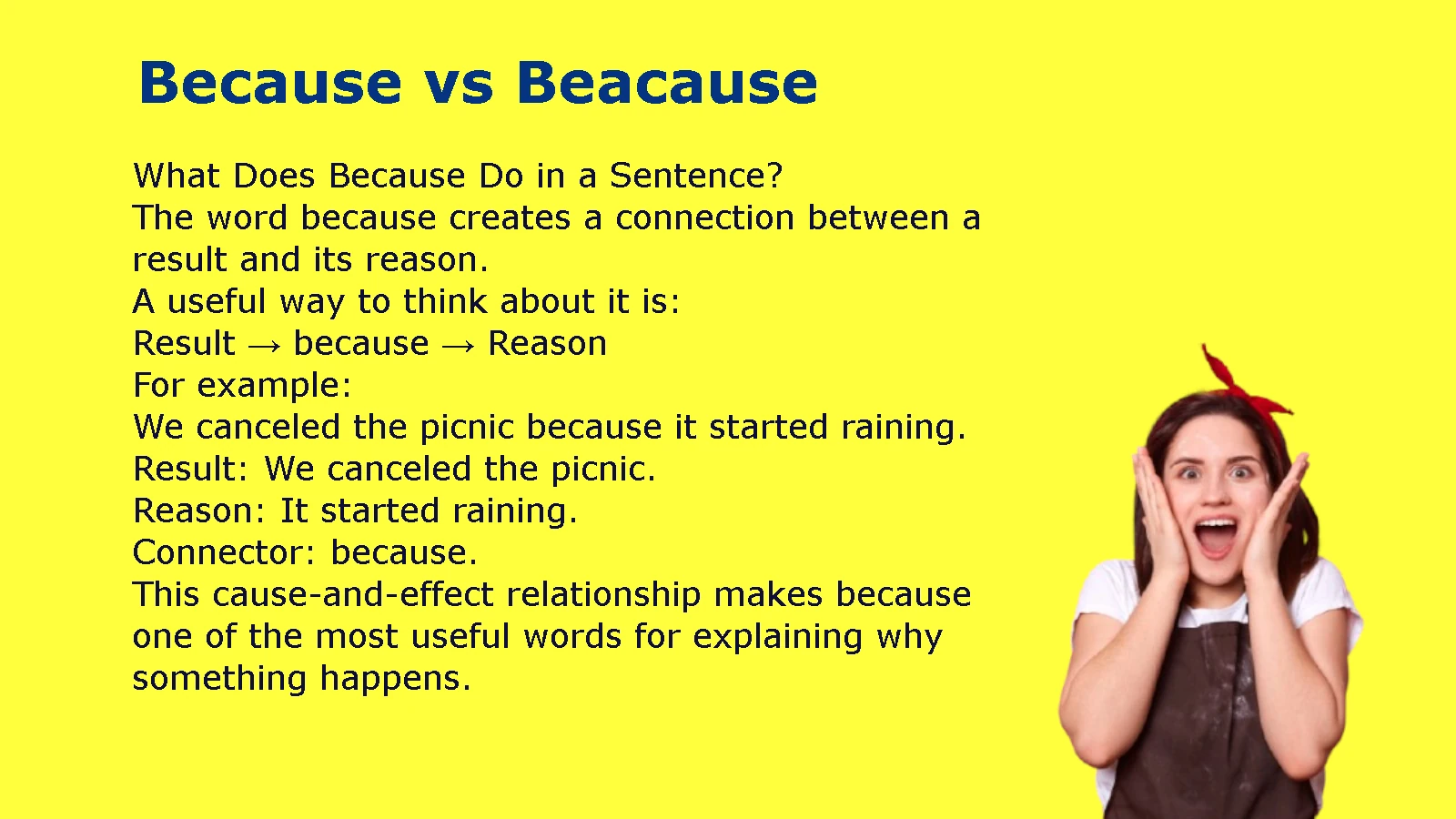
What Does Because Do in a Sentence?
The word because creates a connection between a result and its reason.
A useful way to think about it is:
Result → because → Reason
For example:
We canceled the picnic because it started raining.
- Result: We canceled the picnic.
- Reason: It started raining.
- Connector: because.
This cause-and-effect relationship makes because one of the most useful words for explaining why something happens.
Because as a Subordinating Conjunction
In standard grammatical use, because acts as a subordinating conjunction.
That sounds technical, but the idea is simple. It introduces a dependent clause that gives the reason for the main clause.
For example:
She stayed inside because it was cold.
The clause because it was cold depends on the main clause for its full meaning.
You can also reverse the order:
Because it was cold, she stayed inside.
The meaning remains essentially the same.
Oxford identifies because as a conjunction that introduces a reason.
Beacause Meaning
Beacause is not the correct spelling of a standard English word.
If you see beacause in a sentence, the writer almost certainly intended to write because.
For example:
❌ I stayed home beacause I wasn’t feeling well.
The correction is:
✅ I stayed home because I wasn’t feeling well.
The incorrect version doesn’t become a new word simply because people sometimes type it. It remains a spelling error.
Is Beacause a Word?
No. Beacause is not the standard spelling of the conjunction used to introduce a reason.
It can appear in user-generated text, drafts, search queries, or other informal writing because people make typing and spelling mistakes. That doesn’t give it a separate dictionary meaning.
The standard form is because.
Why Does Beacause Look So Close to Because?
The error usually involves the placement of the vowels in the middle of the word.
Compare:
because → b-e-c-a-u-s-e
beacause → b-e-a-c-a-u-s-e
The misspelling adds an a after be.
This can happen when someone remembers the general sound of the word but not its exact letter sequence. Fast typing can make the problem even easier to miss because the resulting word still looks familiar at a glance.
Because vs Beacause Examples
Seeing the correction in context makes the difference much easier to remember.
| Incorrect | Correct |
| I left early beacause I was tired. | I left early because I was tired. |
| She stayed home beacause it was raining. | She stayed home because it was raining. |
| He apologized beacause he was wrong. | He apologized because he was wrong. |
| We were late beacause of traffic. | We were late because of traffic. |
| They canceled the trip beacause of the storm. | They canceled the trip because of the storm. |
| I called beacause I needed help. | I called because I needed help. |
Notice that the meaning doesn’t change when you correct the spelling. The problem lies entirely in the spelling of the word.
Correct Examples With Because
Here are several natural examples:
- I stayed home because I wasn’t feeling well.
- We arrived early because traffic can get heavy.
- She smiled because she heard good news.
- He couldn’t attend because he had another appointment.
- They moved indoors because it started raining.
- I chose this book because the subject interested me.
- The match ended early because of bad weather.
- She studied every night because she wanted to improve her grades.
- We ordered takeout because nobody wanted to cook.
- He wore a jacket because the temperature had dropped.
Each sentence uses because to explain a reason.
Incorrect Examples With Beacause
These sentences contain the common spelling error:
- ❌ I couldn’t sleep beacause the room was noisy.
- ❌ She missed the bus beacause she woke up late.
- ❌ We went inside beacause it began to rain.
- ❌ He was nervous beacause it was his first interview.
- ❌ They stayed longer beacause they were enjoying themselves.
Correct them by replacing beacause with because.
How to Use Because Correctly
Once you know the spelling, the next step is understanding how because works in actual sentences.
Because to Give a Reason
The most common use of because is to explain why something happened.
I opened the window because the room was warm.
The phrase after because provides the reason for opening the window.
More examples:
We left early because the roads were busy.
She bought a notebook because she needed one for class.
He turned off the lights because everyone had left.
In each example, because introduces an explanation.
Because at the Beginning of a Sentence
You can begin a sentence with a because clause.
For example:
Because it was raining, we canceled the picnic.
When the dependent clause comes first, a comma normally separates it from the main clause. Cambridge specifically notes this punctuation pattern for clauses introduced by because.
Compare:
Because I was tired, I went to bed.
With:
I went to bed because I was tired.
The second sentence doesn’t normally need a comma before because.
This gives you a useful pattern:
Because + reason, result.
Or:
Result + because + reason.
Because in the Middle of a Sentence
Putting because after the main clause is extremely common.
We stayed inside because it was raining.
She took a taxi because she was running late.
I didn’t call because I thought you were busy.
This structure often feels especially natural in everyday conversation.
Because vs Because of
One of the most useful distinctions to learn is the difference between because and because of.
Although both express a reason, they don’t normally take the same grammatical structure.
Because + Clause
Use because before a clause containing a subject and verb.
The flight was delayed because the weather was bad.
The section after because contains:
- Subject: the weather
- Verb: was
Because of + Noun or Noun Phrase
Use because of before a noun or noun phrase.
The flight was delayed because of bad weather.
Here, bad weather is a noun phrase rather than a complete clause.
Collins defines because of as expressing the reason or cause of an event or situation.
Compare the structures:
| Structure | Example |
| because + clause | We stayed inside because it was raining. |
| because of + noun phrase | We stayed inside because of the rain. |
Both sentences explain the same general cause, but their grammar differs.
A Common Because of Mistake
Avoid using because of when a complete clause follows it.
Incorrect:
❌ We stayed home because of it was raining.
Correct:
✅ We stayed home because it was raining.
Or:
✅ We stayed home because of the rain.
That small distinction can make a noticeable difference in formal writing.
Because vs Beacause: Key Differences
The difference between these two forms is not a subtle usage question. One is standard English and the other is a misspelling.
| Feature | Because | Beacause |
| Standard spelling | Yes | No |
| Standard dictionary word | Yes | No |
| Meaning | Gives a reason or cause | None as a standard word |
| Grammar | Usually a subordinating conjunction | None |
| Used in formal writing | Yes | No |
| Used to introduce a reason | Yes | No |
| Correct spelling | Yes | No |
The key point is simple: don’t treat because and beacause as two competing English words. They aren’t.
Why Do People Spell Because as Beacause?
Several factors can make because easy to misspell.
The Letter Sequence Is Easy to Mix Up
The middle of because contains c-a-u, which some writers may accidentally reorder or expand.
The incorrect form beacause adds an a before c.
Compare them visually:
because
beacause
That extra a is the entire problem.
Fast Typing Causes Errors
When people type quickly, familiar words sometimes come out with letters in the wrong order.
Because appears frequently in everyday English, writers may also type it automatically without consciously checking each letter.
A quick spell-check catches many such mistakes, but proofreading still matters.
Pronunciation Doesn’t Reveal Every Letter
English spelling doesn’t always map neatly onto pronunciation.
In normal American English, because has several accepted pronunciations, including forms represented by dictionaries with vowel differences such as /bɪˈkɔz/ and /bɪˈkʌz/.
That means hearing the word doesn’t necessarily tell a learner exactly how to arrange every letter.
Spelling and pronunciation are related, but they aren’t identical systems.
How to Remember the Spelling of Because
A simple memory trick can make because easier to recall.
Remember the Word Cause
The word because contains cause:
be + cause = because
This isn’t a breakdown of the modern word’s grammar. It’s simply a useful spelling aid.
If you’re unsure, look for cause inside the word:
be + cause
That gives you:
because
It also helps connect the spelling with the meaning because because introduces a reason or cause.
Use a Simple Sentence
Try memorizing one sentence:
I stayed home because it rained.
Once because becomes familiar in a complete sentence, its spelling becomes easier to reproduce naturally.
Watch for the Extra A
When proofreading, specifically look for this mistake:
beacause ❌
If you see bea-cause, stop and correct it.
The standard spelling is:
because ✅
Common Misspellings of Because
Beacause isn’t the only spelling error people make with this word.
Other incorrect forms can include:
- beacuse
- becuase
- becasue
- becuse
- becouse
- becuase
The exact error can vary because people may transpose letters, omit letters, or type sounds rather than the standard spelling.
The solution remains the same: because.
Because Spelling Practice
Try correcting these sentences:
- I stayed home beacause I was sick.
- She left early becuase she felt tired.
- We canceled the game beacuse it was raining.
- He called me becasue he needed advice.
Correct versions:
- I stayed home because I was sick.
- She left early because she felt tired.
- We canceled the game because it was raining.
- He called me because he needed advice.
Because vs Since vs As
Several conjunctions can introduce reasons, but they don’t always carry exactly the same emphasis.
Because is especially useful when you want to make the reason clear.
Cambridge notes that because is more common than as and since in both writing and speech. It also explains that because tends to focus attention on the reason.
Compare:
I stayed home because I was sick.
Since I was sick, I stayed home.
As I was sick, I stayed home.
All three can express a similar relationship. However, because directly highlights the reason.
Because vs Since
Since can express time or reason, so context matters.
I’ve lived here since 2020.
Here, since refers to time.
Since it was raining, we stayed inside.
Here, since introduces a reason.
Because avoids that particular ambiguity:
We stayed inside because it was raining.
Because vs As
As can also introduce a reason:
As it was getting late, we decided to leave.
However, as has several other uses in English. Depending on the sentence, it can mean things such as “while,” “in the role of,” or “in the way that.”
Because provides a more direct signal that a reason follows.
Is Because a Conjunction?
Yes. In its standard use, because functions as a subordinating conjunction.
It connects a main clause with a subordinate clause that explains its reason.
For example:
She left early because she felt tired.
The main clause is:
She left early.
The subordinate clause is:
because she felt tired.
The second clause explains why the first event happened.
Cambridge and Oxford both identify this grammatical role and describe because as introducing a reason or cause.
Can You Start a Sentence With Because?
Yes, you can start a sentence with because.
The important point is to make sure the because clause connects to a complete main clause.
Correct:
Because the store was closed, we went somewhere else.
Also correct:
We went somewhere else because the store was closed.
Incorrect as a standalone sentence in standard formal writing:
❌ Because the store was closed.
That leaves the reader waiting for the main point.
In casual conversation, someone might deliberately use a fragment like that for emphasis. Formal writing generally calls for a complete structure.
Can Because Appear After a Comma?
Sometimes, but don’t automatically put a comma before because.
Consider:
I stayed home because I was sick.
No comma is normally needed.
Now compare:
I stayed home, because I was sick.
The second version may appear in some contexts when the writer wants to emphasize the explanation or reflect a particular rhythm. However, the standard straightforward construction usually places no comma before because when the because-clause follows the main clause.
When the because clause comes first, a comma normally follows it:
Because I was sick, I stayed home.
This distinction helps keep your punctuation clean and predictable.
A Practical Case Study: Correcting a Common Email Error
Imagine a workplace email says:
“I couldn’t attend the meeting beacause I had another appointment.”
The meaning is perfectly understandable. The spelling still needs correction.
A polished version would read:
“I couldn’t attend the meeting because I had another appointment.”
Nothing about the message’s meaning changed. One spelling error did, however, make the sentence look less polished.
Now consider a second sentence:
“The meeting was delayed because of technical problems.”
Here, because of works because technical problems is a noun phrase.
Changing it to:
❌ “The meeting was delayed because technical problems.”
would create an incomplete grammatical relationship. You’d need a clause:
✅ “The meeting was delayed because we experienced technical problems.”
This example shows why spelling and grammar should be considered separately. Because must be spelled correctly, but its surrounding structure matters too.
Because in Formal and Informal Writing
Because works comfortably across different registers.
You can use it in:
- School assignments
- Business emails
- Academic writing
- Articles
- Reports
- Everyday conversation
- Text messages
- Personal writing
For example:
The experiment produced inconsistent results because the temperature changed during testing.
That’s appropriate for formal writing.
In conversation:
I didn’t go because I was tired.
That’s perfectly natural too.
Cambridge notes that because is common in both spoken and written English.
Informal Uses of Because
English also has an informal construction in which because appears before a noun, adjective, verb, or interjection without the traditional clause structure.
For example:
I love it because reasons.
Dictionary.com records this informal use, which can appear in humorous or deliberately casual expressions.
This usage shouldn’t be confused with beacause.
The informal construction changes how because functions in a sentence. It does not make beacause an acceptable spelling.
Is Because Always a Conjunction?
In standard grammar, because is primarily taught and used as a subordinating conjunction.
Modern dictionaries also record an informal prepositional use in expressions where because introduces a very short explanation, such as humorous constructions.
For most learners and most formal writing, however, the safest rule remains:
Use because to introduce a reason or cause.
For example:
I left early because I was tired.
That’s the core construction worth mastering.
Because vs Beacause: Quick Reference
If you need a fast answer, use this table:
| Question | Answer |
| Which spelling is correct? | Because |
| Is beacause correct? | No |
| What does because mean? | For the reason that |
| What part of speech is because? | Usually a subordinating conjunction |
| Can because begin a sentence? | Yes |
| Can because introduce a reason? | Yes |
| Can you use because of? | Yes, before a noun or noun phrase |
| Does beacause have a separate meaning? | No standard English meaning |
| Does because work in formal writing? | Yes |
| What’s an easy spelling trick? | Remember be + cause |
Frequently Asked Questions About Because vs Beacause
Is because the correct spelling?
Yes. Because is the standard and correct spelling when you want to introduce a reason or cause.
Is beacause a word?
No. Beacause is a misspelling of because, not a separate standard English word.
What does because mean?
Because means for the reason that or due to the fact that. It introduces an explanation for something.
We stayed home because it was raining.
Why do people write beacause instead of because?
The error usually comes from a letter-order mistake. The extra a in beacause can appear when someone types quickly or remembers the word’s sound without recalling its exact spelling.
How do you spell because correctly?
Spell it:
B-E-C-A-U-S-E
A useful memory aid is be + cause.
Is because a conjunction?
Yes. In its standard grammatical use, because is a subordinating conjunction that introduces a clause explaining a reason.
What’s the difference between because and because of?
Use because before a clause:
We left because it was late.
Use because of before a noun or noun phrase:
We left because of the late hour.
Can you start a sentence with because?
Yes.
Because it was late, we went home.
When the because-clause comes first, a comma normally separates it from the main clause.
What are common misspellings of because?
Common errors include beacause, beacuse, becuase, becasue, becuse, and becouse.
The correct form is always because in standard English.
Is beacause ever correct in formal writing?
No. If you intend the standard conjunction meaning “for the reason that,” use because.
Final Takeaway: Because vs Beacause
The difference between because and beacause is simple once you see the spelling clearly.
Because is correct. It means for the reason that and commonly works as a subordinating conjunction that introduces a reason or cause.
Beacause is a misspelling. It doesn’t represent an alternative spelling or a different grammatical form.
When you’re unsure, remember the helpful visual cue:
be + cause = because
So, if you’re writing an email, essay, article, assignment, or everyday message, choose because.
Because explains the reason. Beacause only creates a spelling mistake.